Count with Matching
Use this tool to count objects with matching.
Overview
This tool is used with a training mode. This means that first a training of the objects to be counted is performed with specified training parameters. The training starts automatically whenever training parameters are set or changed.
The result of the training is immediately displayed in the graphics window. The trained model can then be tested with further images within the same tool.
When objects are counted with matching, first the trained model of the objects is searched in the images. If an instance of the model is found, it is counted as object.
The tool provides a training area on the left of the Tool Board. It enables you to switch between the processing mode for the search and the training mode to train the matching model by clicking on the respective image. The graphics window will display the image of the currently active mode which is highlighted in blue in the training area. In addition to the search parameters on the top left, the tool provides further parameters for the training on the top right of the tool.
See the topic Working with the Training Mode to learn more about how to work with tools that require a training.
The Tool Board is split into the training area on the left of the and the graphics window on the right.
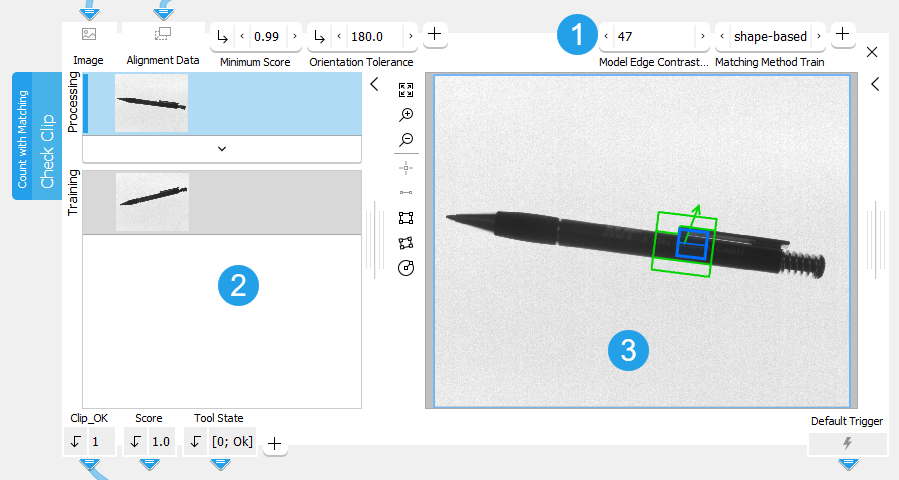
 Training parameters
 Training area
 Graphics window
Defining the Training Settings
Selecting the Training Image
The first image on the left side of the Tool Board shows the image that is currently loaded, the second one shows the training image.
For this tool only one image can be used as training image. When the tool is inserted, the current processing image is automatically used as training image. You may also change the training image with the following steps:
- Run the application in single steps until the desired image is displayed in the graphics window and thus in the "Processing" area.
- Click on the
 button in the training area on the left to replace the current training image with the image from the "Processing" area. The training mode is automatically activated and the new training image is displayed in the graphics window.
Selecting the Matching Model
For this tool easyTouch and easyTouch+ are available. This means you may select the matching model for the alignment interactively as follows:
- Click on the training image on the left of the Tool Board. The training image will be displayed in the graphics window and you may start with the selection of the matching model.
- Move the mouse over the image to display a preview of regions of interest (ROI) for the model. Alternatively draw a model ROI using the ROI selection buttons. When using easyTouch to select the model, the color of the previewed model ROI is an indicator for the suitability of the ROI, i.e., of the object inside the rectangle, for the training. The accuracy, the scale, and the rotation invariance depend on the contrast, the size, and the shape of the underlying object. The meaning of the different colors is as follows:
- A potentially good model ROI is highlighted in the color defined for "accepted", e.g., green by default.
- If the model ROI is highlighted in the color defined for "warning", e.g., yellow by default, it might not be the best for the training, e.g., due to missing or too few model edges.
- A bad model ROI is highlighted in the color defined for "rejected", e.g., red by default. If the rectangle is very close to the image border, it is visualized in red because the object may only be partially visible in the processing images.
- If you want to use the highlighted ROI for the alignment, click on the ROI to confirm the selection. The corresponding training parameters are determined automatically.
To increase the robustness of the training with respect to rotation variations, we recommend to select two different model ROIs and thus train a matching model with two ROIs that are at best on opposite sides of the image.
Defining the Search Settings
Adjusting the Search Parameters
In contrast to the training parameters, the search parameters on the left side are not automatically adjusted. They depend on the images of your application and should be adjusted accordingly.
You can check if the current settings of the training and search parameters are suitable. Run the application with a series of images and you can instantly check in the graphics window if the trained matching model is correctly found in the images. If necessary, you can make further adjustments at the parameters.
Area Restrictions
The objects are searched within an area that is determined by the "Processing Region" and "Search ROI".
An object is returned, if its center of gravity lies inside of this search area. In case the center of gravity lies outside of the objects the search area should be adjusted thus that the search area includes the center of gravity. This ensures that the object is found.
Objects, which lie partially outside of the image, will be ignored during the processing.
Parameters
Depending on the selected training method at the parameter "Matching Method Train", some connectors are grayed out. This means that they are not applicable for the currently selected training method and thus have no effect.
Basic Parameters
Image:
This parameter represents the image in which the object should be counted. It can be used either as a training image to determine the matching model or it can be used as a processing image to test the determined matching model.
If a color image is used as input image for this tool, only the first channel, i.e., the red channel, is used for the processing.
Minimum Score:
This parameter is a numeric value that defines how accurate the matching is done for the counting. It determines how much of the trained model must be visible in the image to find a match. It is set to 0.5 by default. This means that half of the model may be occluded in the image. You can change its value at the corresponding connector. The value can be set to a number between 0.1 and 1. The higher the "Minimum Score" the faster is the search. If the model can be expected never to be occluded in the images, the "Minimum Score" may be set as high as 0.8 or even 0.9.
To speed up the search, a so-called pyramid of contracted images is used. A match needs a score that is large enough on every level to be recognized as such. This can lead to excluding matches, although their score on the original image is larger than the minimal score, because they are not recognizable enough on a higher contraction level. These missed matches may be found with a lowered minimum score.
You may test the current "Minimum Score" by running the application step by step and check if the presence of the objects is found correctly within all images.
Orientation Tolerance:
This parameter defines the tolerance for the rotation in which the object may appear in the image. It is defined in degrees and set to 180° by default. You can change the "Orientation Tolerance" to an angle between 0° and 180° at the corresponding connector.
Additional Parameters
Search ROI:
This parameter defines the region of interest (ROI) for processing. Image parts outside of the union of the ROI and "Processing Region" are not processed.In addition, if either of them is empty, the image part inside of the other one is processed. In case both of them are empty, the whole image is processed. However, if easyTouch is used to select the matching model, the whole image is used for the processing.
By default the "Search ROI" is defined as empty ROI. If you want to use a non-empty "Search ROI" for the processing, you either have to connect the parameter to an appropriate ROI result of a previous tool to make sure that an ROI is transmitted to this tool or you have to draw new ROIs into the image using the available ROI buttons. If you are using an ROI result of a previous tool, you can also draw additional ROIs using the ROI buttons.
It may be sufficient if only a part of the trained model, e.g., only one of two model ROIs, lies within the search area to find a match. However, if the trained model lies outside of this area, it is not found.
Alignment Data:
This parameter represents the alignment data that are used to align the ROI. By default no alignment data are connected and thus no effect is visible. If you want to use specific alignment data, you have to connect the parameter to an appropriate result of a previous tool such as Determine Alignment with Matching, Determine Alignment with Straight Border, Align Image, or Rotate Image.
Maximum Number of Objects:
This parameter defines the "Maximum Number of Objects" that should be counted in an image. It can be used to define the expected number of objects. It is set to 50 by default. This means if more than 50 objects with a score greater than the "Minimum Score" are found in the image, only the best 50 objects are returned. You can change the value at the corresponding connector. Increasing the "Maximum Number of Objects" might lead to a longer search time.
If "Maximum Number of Objects" is set to 0, no upper limit is set for the number of objects. This means that all objects exceeding "Minimum Score" will be found.
Deformation Tolerance:
This parameter defines the maximum allowable deformation of the object. It is defined in pixels and set to 1 px by default. This means that objects that are deformed up to 1 px with respect to the shape of the trained model are also found. You can change its value at the corresponding connector to an integer value between 0 and 5 px and above if you enter the value manually. If you set the value to 0 px, only objects without any deformations are found. However, the higher the "Deformation Tolerance" the higher is the risk that wrong objects are found, especially for objects with fine structures.
The "Deformation Tolerance" should therefore be chosen as small as possible and only as high as necessary. If it is known how much deformation of the model may be expected in the images, you can adjust the value for the "Deformation Tolerance" accordingly. The "Deformation Tolerance" only is valid if "Matching Method Train" is set to "shape-based".
Maximum Overlap:
This parameter defines the maximum allowable overlap of the objects to be counted, i.e., it defines a tolerance for this overlap. The overlap is determined with respect to the smallest surrounding rectangle around the object and not the area of the object itself. Therefore it is possible that two objects overlap even though their actual areas do not intersect. The "Maximum Overlap" is represented as a percentage value and set to 50% by default. This means that up to 50% of the smallest surrounding rectangle of an object may be occluded in the search image to be included in the counting. If more than 50% of the object is occluded, it is not counted. You can change its value at the corresponding connector to a value between 0 and 100. If you set the value to 0, only objects without any overlap are found. However, the higher the "Maximum Overlap", the higher is the risk that wrong objects are found.
Processing Region:
This parameter defines the region for processing. Image parts outside of the union of the ROI and "Processing Region" are not processed. In addition, if either of them is empty, the image part inside of the other one is processed. In case both of them are empty, the whole image is processed.
By default, "Processing Region" is defined as empty region. To specify a "Processing Region", you have to connect the parameter to an appropriate region result of a previous tool to make sure that a region is transmitted to this tool.
If easyTouch is used to select the matching model, the whole image is used for the processing.
Training Parameters
Basic Training Parameters
Matching Method Train:
This training parameter defines the matching method that is used for the determination of the training model. The parameter is set to "shape-based" by default. You can change the "Matching Method Train" at the corresponding connector.
|
Value |
Description |
|---|---|
|
shape-based |
This matching approach describes the trained model by the shapes of its contours. Use this method, if you want to determine the training model with a matching method that finds the best matches of a shape model in an image. |
|
correlation-based |
This matching approach describes the trained model by the gray value relations of the contained pixels. Use this method, if you want to determine the training model with a matching method that uses normalized cross correlation (NCC) to match objects or patterns. |
Additional Training Parameters
The additional training parameters are listed by the matching method they are related to. Parameters of other methods can be set but will have no influence on the resulting training model.
 Training parameters for the "shape-based" matching:
Model Edge Contrast Train
Training parameters for the "shape-based" matching:
Model Edge Contrast Train
This training parameter defines the edge contrast of the used model. It is defined in gray values and set to 10 by default. This means that objects with a contrast of at least 11 gray values will be found. There are different ways to set the edge contrast:
- Automatically with easyTouch
Use easyTouch to select the objects in the training image. The parameter value is automatically adjusted according to your easyTouch selection.
- Automatically using the region of interests (ROIs)
Set the edge contrast manually to 0 at the connector and draw a model ROI over each part in the training image in which you want to find reference objects. The tool automatically detects all possible objects with any contrast. If you want to add further objects as reference for the training, you have to make sure to draw the model ROI manually into the image. The parameter value at the connector remains 0 until you change the value manually or use easyTouch.
- Manually
Set the desired edge contrast manually at the corresponding connector and draw a model ROI over each part in the training image in which you want to find reference objects. You can set the value with the slider or type a value between 1 to 1 000 000 000 into the text field. All possible objects that fit to the defined edge contrast will be found. If you want to add further objects as reference for the training, you have to make sure to draw the model ROI manually into the image. When using easyTouch to select the objects, the parameter value is adjusted automatically and your previously defined setting will be lost.
Search Edge Contrast Train
This training parameter defines the edge contrast that is used for the search of the objects in the training images. It is defined in gray values and set to 5 by default. This means that objects with a contrast of at least 6 gray values will be found. There are different ways to set the edge contrast:
- Automatically witheasyTouch
Use easyTouch to select the objects in the training image. The parameter value is automatically adjusted according to your easyTouch selection.
- Automatically using the region of interests (ROIs)
Set the edge contrast manually to 0 at the connector and draw a model ROI over each part in the training image from which the edge contrast shall be determined and used for the search. The tool automatically detects all possible objects with any contrast. If you want to add further objects as reference for the edge contrast, you have to make sure to draw the model ROI manually into the image. The parameter value at the connector remains 0 until you change the value manually or use easyTouch.
- Manually
Set the desired edge contrast manually at the corresponding connector and draw a model ROI over each part in the training image in which you want to determine the edges with the defined contrast. You can set the value with the slider or type a value between 1 to 1 000 000 000 into the text field. All possible objects that fit to the defined edge contrast will be found. If you want to add further objects as reference for the training, you have to make sure to draw the model ROI manually into the image. When using easyTouch to select the objects, the parameter value is adjusted automatically and your previously defined setting will be lost.
Highest Pyramid Level Train
This parameter defines the number of pyramid levels used during the search. It is set to "auto" by default. The "Highest Pyramid Level" is determined automatically by easyTouch when a model ROI has been selected in the training image. You can also change its value manually at the corresponding connector to a level between 2 and 8. It should be set as large as possible to reduce the time needed to find the object. However, if it is set too large, the model may not be recognized anymore. Thus it should also be set small enough that the model is still recognizable.
The selection of the suitable pyramid level, i.e., the highest pyramid level on which at least one instance of the shape model can be found, depends on the model and on the input image. The appropriate "Highest Pyramid Level" may vary from image to image. If the input image is of poor quality, i.e., the image is defocused, deformed, or noisy, it may be possible that no instance of the model is found with the default setting because of possibly missing or deformed edges. In this case decrease the value for the "Highest Pyramid Level".
If the parameter "Highest Pyramid Level" is set too small, the time required to find the model may increase and cause MERLIC to be very slow. This is especially the case if images with a large size are used. In this case we recommend to increase the value for "Highest Pyramid Level".
Minimum Edge Length Train
This training parameter defines the minimum length of the used model edges. It is defined in pixels and set to 5 px by default. There are different ways to determine the length of the edges:
- Automatically with easyTouch
Use easyTouch to select the objects in the training image. The parameter value is automatically adjusted according to your easyTouch selection.
- Automatically using the region of interests (ROIs)
Set the edge contrast manually to 0 at the connector and draw a model ROI over each part in the training image in which you want to determine the minimum length of edges for the training. The tool automatically detects the minimum length of all possible edges. If you want to add further objects for the training, you have to make sure to draw the model ROI manually into the image. The parameter value at the connector remains 0 until you change the value manually or use easyTouch.
- Manually
Set the desired edge length manually at the corresponding connector and draw a model ROI over each part in the training image in which you want to find edges with the defined length. This enables you to define that only model edges with the specified minimum length are included in the training. You can set the value with the slider or type a value between 1 to 1 000 000 000 px into the text field. If you want to add further objects for the training, you have to make sure to draw the model ROI manually into the image. When using easyTouch to select the objects, the parameter value is adjusted automatically and your previously defined setting will be lost.
Polarity Metric Train
The parameter determines the conditions under which the model is recognized in the image. It is set to "use polarity" by default.
|
Value |
Description |
|---|---|
|
use polarity |
If this polarity metric is used, the object in the training image and the processing image must have the same contrast, e.g., if the model is a bright object on a dark background, the object is found only if it is also brighter than the background. This metric can only be applied to single-channel images. If a multichannel image is used as the training image or as the processing image, only the first channel will be used. |
|
ignore color polarity |
If this polarity metric is used, the model is found even if the color contrast changes locally, e.g., if parts of the object change their color from green to red. This mode is useful if you do not know in advance in which channels the object is visible. However, the run time in the processing mode can increase significantly with this polarity metric. This metric can be used for images with an arbitrary number of channels. If it is used for single-channel images, it has the same effect as "ignore local polarity". The number of channels in the creation of the training model and the search can be different. This can be used to create a model from a synthetically generated single-channel image. Furthermore, the channels do not need to contain a spectral subdivision of the light like in an RGB image. The channels can also contain images of the same object that were obtained by illuminating the object from different directions. |
|
ignore global polarity |
If this polarity metric is used, the model is found in the image also if the contrast reverses globally, e.g., if the model is a bright object on a dark background, the object is not only found if it is brighter than the background (as for "use polarity") but also if it is darker than the background. In this case, the run time in the processing mode will increase slightly. This metric can only be applied to single-channel images. If a multichannel image is used as the training image or as the processing image, only the first channel will be used. |
|
ignore local polarity |
If this polarity metric is used, the model is found even if the contrast changes locally. This is useful if the object consists of a part with medium gray value, within which either darker or brighter sub-objects lie. However, the run time in the processing mode can increase significantly with this polarity metric. This metric can only be applied to single-channel images. If a multichannel image is used as the training image or as the processing image, only the first channel will be used. |
Training parameters for the correlation-based matching:
Highest Pyramid Level Train
This parameter defines the number of pyramid levels used during the search. The parameter is set to "auto" by default. The "Highest Pyramid Level" is determined automatically by easyTouch when a model ROI has been selected in the training image. You can also change its value manually at the corresponding connector to a level between 2 and 8. It should be set as large as possible to reduce the time needed to find the object. However, if it is set too large, the model may not be recognized anymore. Thus it should also be set small enough that the model is still recognizable.
The selection of the suitable pyramid level, i.e., the highest pyramid level on which at least one instance of the shape model can be found, depends on the model and on the input image. The appropriate "Highest Pyramid Level" may vary from image to image. If the input image is of poor quality, i.e., the image is defocused, deformed, or noisy, it may be possible that no instance of the model is found with the default setting because of possibly missing or deformed edges. In this case decrease the value for the "Highest Pyramid Level".
If the parameter "Highest Pyramid Level" is set too small, the time required to find the model may increase and cause MERLIC to be very slow. This is especially the case if images with a large size are used. In this case we recommend to increase the value for "Highest Pyramid Level".
Polarity Metric Train
The parameter determines the conditions under which the model is recognized in the image. It is set to "use polarity" by default.
|
Value |
Description |
|---|---|
|
use polarity |
If this polarity metric is used, the object in the training image and the processing image must have the same contrast, e.g., if the model is a bright object on a dark background, the object is found only if it is also brighter than the background. This metric can only be applied to single-channel images. If a multichannel image is used as the training image or as the processing image, only the first channel will be used. |
|
ignore color polarity |
If this polarity metric is used, the model is found even if the color contrast changes locally, e.g., if parts of the object change their color from green to red. This mode is useful if you do not know in advance in which channels the object is visible. However, the run time in the processing mode can increase significantly with this polarity metric. This metric can be used for images with an arbitrary number of channels. If it is used for single-channel images, it has the same effect as "ignore local polarity". The number of channels in the creation of the training model and the search can be different. This can be used to create a model from a synthetically generated single-channel image. Furthermore, the channels do not need to contain a spectral subdivision of the light like in an RGB image. The channels can also contain images of the same object that were obtained by illuminating the object from different directions. |
|
ignore global polarity |
If this polarity metric is used, the model is found in the image also if the contrast reverses globally, e.g., if the model is a bright object on a dark background, the object is not only found if it is brighter than the background (as for "use polarity") but also if it is darker than the background. In this case, the run time in the processing mode will increase slightly. This metric can only be applied to single-channel images. If a multichannel image is used as the training image or as the processing image, only the first channel will be used. |
|
ignore local polarity |
If this polarity metric is used, the model is found even if the contrast changes locally. This is useful if the object consists of a part with medium gray value, within which either darker or brighter sub-objects lie. However, the run time in the processing mode can increase significantly with this polarity metric. This metric can only be applied to single-channel images. If a multichannel image is used as the training image or as the processing image, only the first channel will be used. |
Results
Basic Results
Number:
This result contains the "Number" of objects that are counted with the specified parameters. The result is returned as an integer number.
Score:
This result returns a numeric value that indicates how much the counted object matches the trained model that is searched. The result is returned as a real number between 0 and 1. If the "Score" has the value 1, the found object matches the trained model with an accuracy of 100%. If more than one object is found, the corresponding scores are returned as a tuple.
Tool State:
"Tool State" returns information about the state of the tool and thus can be used for error handling. Please see the topic Tool State Result for more information about the different tool state results.
Additional Results
Model Edges:
This result contains the contour of the trained model edges.
Orientation Arrow:
This result represents the "Orientation Arrow" of the ROI that has been used for the training. It is returned in form of a contour.
Processing Time:
This result returns the duration of the most recent execution of the tool in milliseconds. The result is provided as additional result. Therefore, it is hidden by default but it can be displayed via the  button beside the tool results. For more information see the section Processing Time in the tool reference overview.
Application Examples
This tool is used in the following MERLIC Vision App examples:
- check_pen_parts.mvapp
- count_frozen_dough_with_training.mvapp