Write Access in the Frontend
When starting MERLIC RTE, the control over MERLIC is granted to the connected communication device or industrial control system. This means that no user interactions are possible while MERLIC is running in process integration mode. However, you have the possibility to activate a write mode for the Frontend during the process integration. This mode, called "OperationalFrontendAccessMode", is one of the MERLIC states and is activated via the Designer widget Write Access.
When the control is switched to the Frontend, the internal state of MERLIC changes to "OperationalFrontendAccessMode". The respective communication device or control system is not allowed to trigger any commands for the execution of the MVApp or loading a recipe file. In case of digital I/O devices or camera devices with GenICam compliant digital I/O channels, the "Ready" signal is set to 0 when MERLIC is in "OperationalFrontendAccessMode". However, it is still possible to query the results of the MVApp execution. When checking the MERLIC state it is possible that the "Ready" signal is set to 1 briefly. If a digital I/O device is used, all its previously set result signals will be set to zero when the Frontend access is engaged.
If you are using a digital I/O device or camera device with GenICam compliant digital I/O channels, the value of the "Ready" signal could lead to a misconception about the current state of MERLIC because the "Ready" signal is also expected to be set to 0 if MERLIC processes a command of the communication device or the control system, e.g., the "StartSingleJob" command.
For example, if the communication device or control system triggers the "StartSingleJob" command, the respective signal for the single execution is set to 1. MERLIC starts with the single execution as soon as the command has been recognized. If a user activates the write mode for the Frontend and MERLIC receives this request exactly during the time delay in which the signal for the single execution has not yet been recognized, MERLIC will change to the "OperationalFrontendAccessMode" mode because the respective request was recognized first. The expected single execution will not be processed successfully. However, it might seem as if MERLIC processes the "StartSingleJob" command because the "Ready" signal has been set to 0. It is not possible to track why the "Ready" signal has been set to 0 because internal MERLIC states "SingleExecution" and "OperationalFrontendAccessMode" cannot be queried when using a digital I/O device or camera devices with GenICam compliant digital I/O channels.
To avoid any misconceptions and to ensure a correct manufacturing process, we recommend to switch the control over MERLIC to the Frontend only with careful consideration of the current manufacturing process and in synchronization with the machine controller. We also recommend to restrict the right to activate the write mode to a selected group of users to ensure that only authorized users have access to this functionality. For more information about the user management of MERLIC, see Setting up the User Management.
Enabling the Activation of the Write Mode
The write mode for the Frontend during the process integration mode can only be activated via the Designer widget Write Access. Therefore, you have to add the widget to the Frontend design of your MERLIC Vision Apps to ensure that the widget is available when the process integration mode is running.
- Open the MVApp in the MERLIC Creator.
- Open the MERLIC Designer.
- Add the widget "Write Access" from the "Widget Library" to your Frontend design.
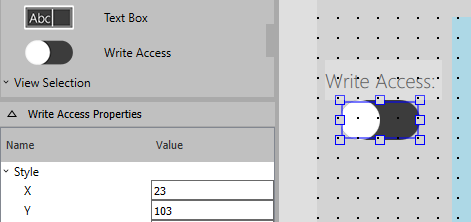
- Optionally, customize the layout and properties of the widget.
- Save the changes in your MVApp.
If you want to enable the activation of the write mode only for a selected group of users, you can use the MERLIC user management and design the Frontend with multiple views. This way, you can add the "Write Access" widget to a specific view that is only accessible for selected users. For more information about the user management and how to work with multiple views in the Frontend, see Setting up the User Management and Working with Views.
Acquiring Write Access for the Frontend
If MERLIC is running in the process integration mode and the "Write Access" widget is available in the Frontend of the MVApp, you can activate the write mode for the Frontend.
Click on the handle of the "Write Access" widget to activate the write mode.
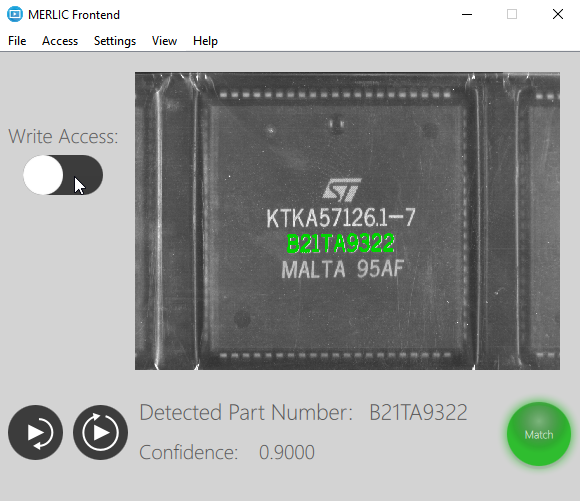
As soon as you have acquired the write access for the Frontend, you can start to edit the MVApp in the Frontend, for example, trigger an execution via the "Execution Control" widget or adjust parameter settings.
The write mode for the Frontend during the process integration mode remains active until it is explicitly released. To switch the control back to your communication device or industrial control system, you have to release the write lock explicitly in the Frontend.
Releasing the Write Lock
To transfer the control over MERLIC back to the communication device or industrial control system, you have to release the write lock explicitly in the Frontend. You can choose between several options:
-
Click on the handle of the "Write Access" widget to release the write lock.
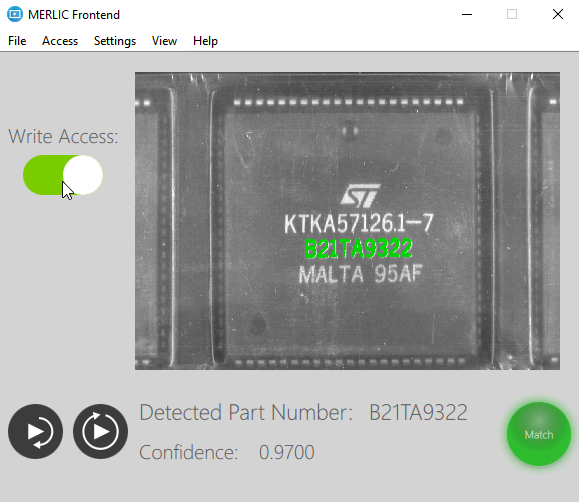
- Open the Frontend menu "Access" and click on "Release write lock".
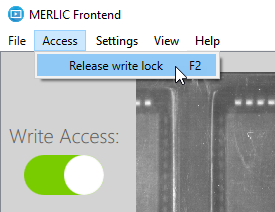
- Use the keyboard shortcut F2 to release the write lock.
- Close the Frontend window. The write lock is automatically released.
After releasing the write lock, user interactions in the Frontend are not possible anymore and the write permission is back at your communication device or industrial control system. The internal state of MERLIC changes to "Ready" (via the modes "Preoperational" and "OperationalAutomaticMode"). If a digital I/O devices or camera devices with GenICam compliant digital I/O channels is used, the "Ready" signal is set to 1 to indicate that MERLIC is ready for commands from the device.
It is not possible to adjust any values of the recipe file from the Frontend. If you made any changes at parameter values that are actually set via the recipe file, you cannot adopt these changes in the recipe.
These changes will be lost when a recipe file is loaded, that is, when the control over MERLIC is switched back to your communication device or industrial control system and the "PrepareRecipe" command is triggered. Releasing the write lock does not cause the recipe file to be reloaded. Therefore, these kind of changes remain in the current application only as long as the "PrepareRecipe" command is not triggered.