Configuring Communication Plug-ins
The configuration of all types of communication plug-ins can be adjusted in the "Communication" tab of the MERLIC RTE Setup. The list of plug-in instances on the left of the MERLIC RTE Setup shows all plug-in instances that have already been added to the MERLIC RTE Setup for the configuration. If the plug-in you want to configure is missing in the list, you have to add an instance of this plug-in as described in Adding a Plug-in Instance.
Enabling the Configuration in the MERLIC RTE Setup
To enable the configuration of a plug-in instance, you first have to start MERLIC RTE and perform the following steps:
- Open the MERLIC RTE Setup and go to the "Communication" tab. If MERLIC RTE is not running, you can start it directly from the "Communication" tab.
- Add the desired plug-in instance on the left.
- Make sure that the plug-in is currently not running. Otherwise, the parameters are not available for the configuration. You can see the current state of the plug-in at the respective status icon in the list of plug-in instances. If the status shows the icon
 , the plug-in is running. In this case, you have to stop it by clicking the "
 Stop plug-in" button on the bottom of the MERLIC RTE Setup. If the status shows the icon
  instead, the plug-in is currently not running. In the example image below, the selected instance of the MQTT plug-in is currently not running as indicated by the icon and therefore the configuration of this MQTT instance is possible.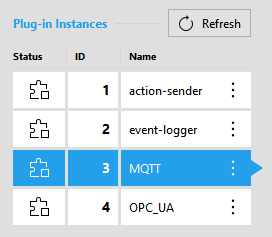
-
Select the plug-in instance on the left to display its parameters and to start with the configuration.
Overview of the Parameters
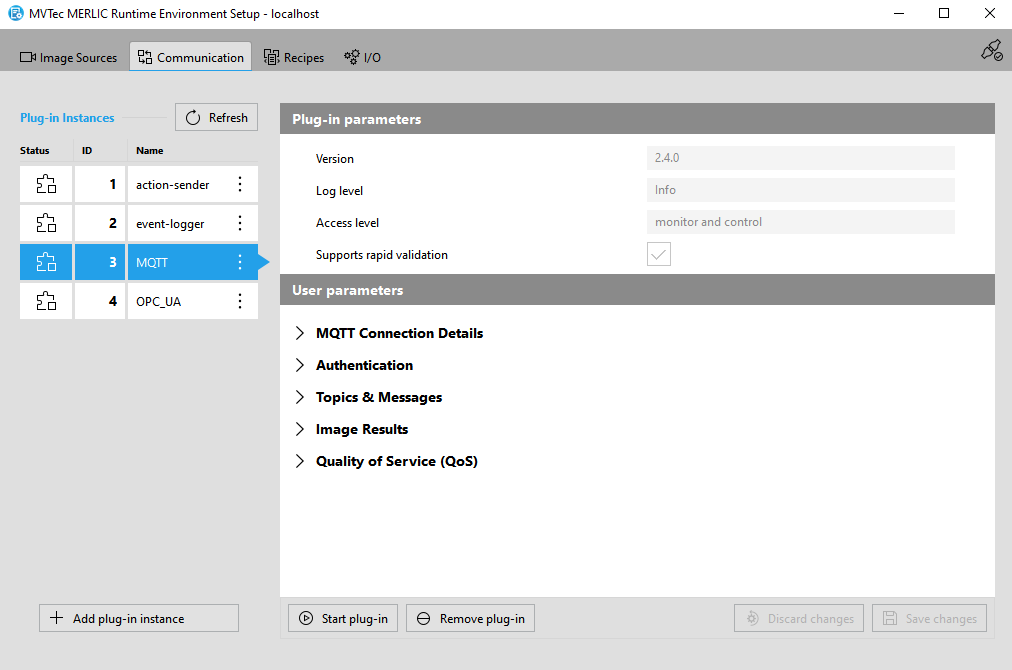
On the right of the "Communication" tab, you can see the parameters of the currently selected plug-in instance. Make sure to select the plug-in instance on the left whose parameters you want to see and configure.
The parameters are differentiated in "Plug-in parameters" and "User parameters" as shown below.
Plug-in Parameters
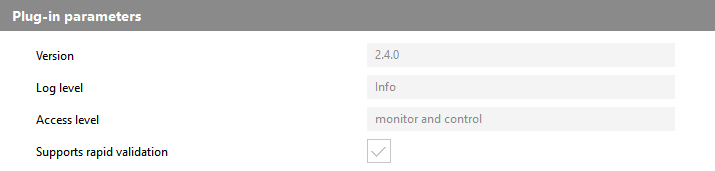
Parameters of this type represent general parameters for the communication plug-in that cannot be adjusted in the configuration area of the "Communication" tab. They may show the version number of the plug-in, the current parameter value for the log level, the access level of the plug-in, and the setting for the validation of the plug-in configuration. These values need to be set in different locations or with different methods, respectively.
Version
This parameter shows the version number that has been defined during the plug-in implementation. It consists of a major, minor, and maintenance version. It is also shown when adding a new plug-in instance. The version is optional. Therefore, it is possible that no version number has been defined during the implementation.
Log level
This parameter shows the log level of the plug-in instance. By default, the log level is set to the log level of the respective MERLIC RTE process when adding the plug-in instance in the MERLIC RTE Setup.
You can set the log level for MERLIC RTE via the "Threshold" property in the INI file. For more information, see the section [Logging] in The MERLIC INI File and Logging.
Access level
This parameter shows the access level that is set for the plug-in. The access level correlates with the capability that is defined in the implementation of the plug-in. The access level cannot be adjusted in the MERLIC RTE Setup.
Supports rapid validation
This parameter shows whether the plug-in supports the immediate validation of the current plug-in configuration. For this plug-in, the check box is ticked indicating that "rapid validation" is supported. This means that the configuration of the plug-in is validated with each modification of any editable parameter in the "Communication" tab of the MERLIC RTE Setup. If the plug-in does not support "rapid validation", the configuration of the plug-in is validated only when saving the configuration.
User parameters
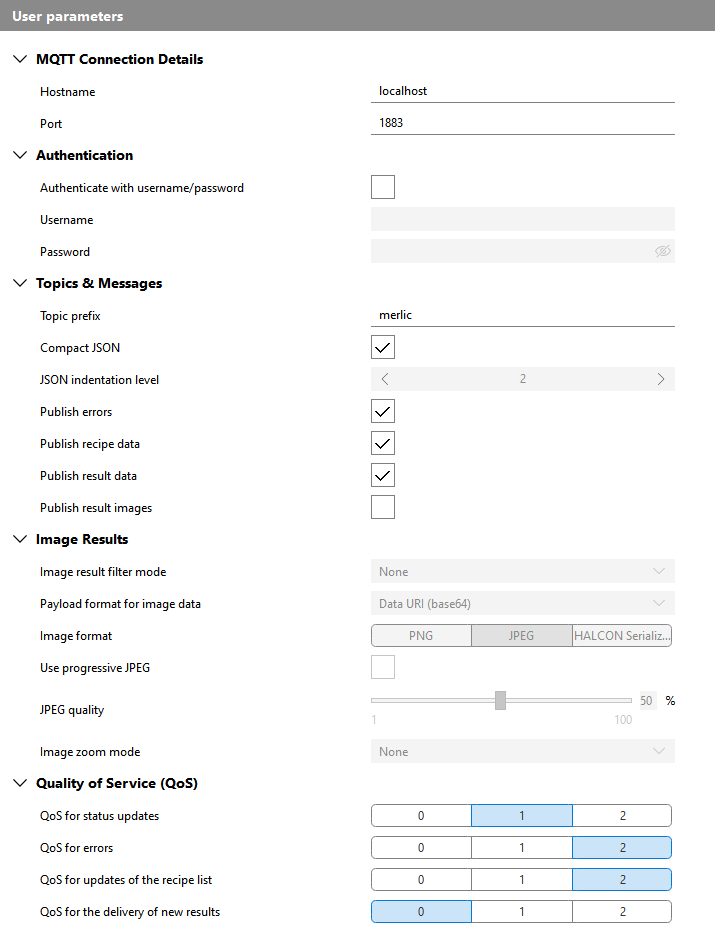
The parameters in this section can be configured depending on the implementation of the respective plug-in. The set of parameters and the parameter categories may differ for each plug-in. For example, the available "User parameters" of the MQTT plug-in are the following:
Configuring the User Parameters of a Plug-in
To configure an instance of a communication plug-in, you can proceed as follows:
- Enable the plug-in instance and make sure that the plug-in instance is not running as described in Enabling the Configuration in the MERLIC RTE Setup.
- Adjust the user parameters of the plug-ins instance as required for your application. Depending on the implementation of the respective plug-in, only predefined value ranges may be allowed.
- Make sure to save the changes. Otherwise, the plug-in cannot be started.
Saving the configuration will trigger a validation of the parameters. The validation itself is plug-in-specific and might result in error or warning messages alerting you to invalid or otherwise problematic configuration values. The validation can also result in certain parameters being enabled or disabled for configuration dependent upon the values of certain other parameters. In the example above, you can see that the parameter "JSON indentation level" is not applicable because the parameter "Compact JSON" is activated, that is, is set to "true". When you uncheck the checkbox for "Compact JSON", the "JSON indentation level" will only become configurable after you save that change and thus validate the configuration.
You can also discard unsaved changes via the button " Discard changes" if you want to restore the last saved state of the configuration. However, it is not possible to start a plug-in if there are still any unsaved changes.
Image Results
If a communication plug-ins supports the retrieval of image results, the plug-in configuration might provide some user parameters to define various settings related to the image results. Keep in mind that the image results must be defined as MVApp results to enable the transmission during the process integration.
In general, all images of the types "byte", "int1", "uint2", "int2", int4", "int8", and "real" can be exported as an MVApp result. Using MERLIC RTE, it is possible to fetch them in one of three data formats: HALCON Serialized Item, JPEG, and PNG. The image type "real" forms an exception, because you can export it only as HALCON Serialized Item. To export images of the type "real" as JPEG or PNG, you can first convert them to a "byte" image using the MERLIC tool Scale Gray Range to 8 Bit.
HALCON Serialized Item
This format allows for a lossless pixel value transformation. However, HALCON Serialized Item is a proprietary format that can only be used by users who also work with MVTec HALCON. For more information, please refer to the HALCON documentation.
JPEG
JPEG images support up to three channels. Based on the image type and the data format to be fetched, the following pixel value transformations take place:
Pixel type | Pixel transformation |
|---|---|
byte | No further transformation is required. |
int1 | +128 will be added to each value in order to lift the value range from −128 ... 127 to 0 ... 255. |
uint2, int2, int4, int8 | The entire data type range will be shifted and scaled down to 0 ... 255. |
PNG
PNG images support up to four channels. Based on the image type and the data format to be fetched, the following pixel value transformations take place:
Pixel type | PNG size | Pixel transformation |
|---|---|---|
byte | 8 bit | lossless |
int1 | 8 bit | +128 will be added to each value in order to lift the value range from −128 ... 127 to 0 ... 255. |
uint2 | 16 bit | lossless |
int2 | 16 bit | +32 768 will be added to each value in order to lift the value range from −32 768 ... 32 767 to 0 ... 216-1. |
int4, int8 | 16 bit | The entire data type range will be shifted and scaled down to 0 ... 216-1. |