Connecting the MERLIC Frontend to a Remote Server
MERLIC offers various ways to connect a MERLIC Frontend to a MERLIC server running on a remote system. You can connect via the graphical user interface of the MERLIC Frontend, via command line options, or by defining the respective settings in the INI configuration file.
To enable a remote connection, you need to specify the MERLIC server to which the Frontend should connect to, that is, the hostname or IP address of the MERLIC server and the port to be used. A MERLIC server is part of the MERLIC core The processing unit of a running MERLIC Vision App. that was started on a host machine.
Prerequisites
To enable a remote connection, the following prerequisites must be fulfilled:
- MERLIC must be installed on the local system as well as remote system you want to connect to.
- On the remote system, either MERLIC Creator or MERLIC RTE must be running.
- The maximum number of allowed simultaneous connected MERLIC Frontends is not exceeded.
Compatibility of remote Frontend connections between MERLIC 26.03.2 and older version:
When connecting the Frontend of a MERLIC 26.03.2 installation remotely to an instance of the MERLIC Creator or MERLIC RTE of a MERLIC 5.1 installation (or older), the connection succeeds but the Frontend window remains blank. Vice versa, the Frontend of a MERLIC 5.1 (or older) installation fails to display the Frontend served up by an instance of MERLIC Creator or MERLIC RTE of a MERLIC 26.03.2 installation.
Connecting to a Server via the MERLIC Frontend Menu
This option is only available if the menu bar of the MERLIC Frontend is activated for the currently loaded MERLIC Vision App (MVApp).
- In the Frontend menu bar, click on the menu entry "Access" and select "
 Connect to server...". Alternatively, click on the button on the right of the Frontend menu.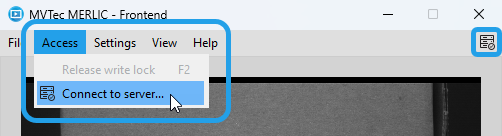
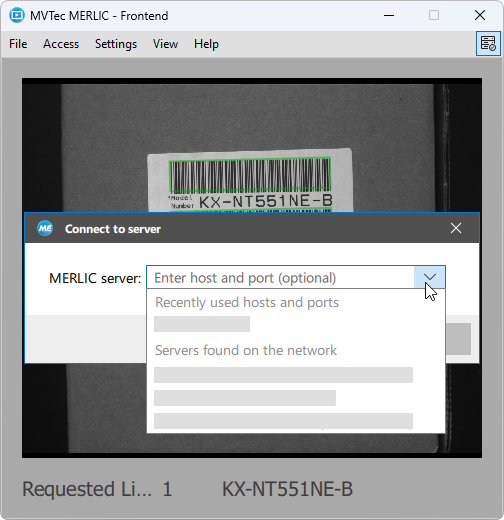
- Select the hostname or IP address of the server and optionally the desired TCP/IP port. Open the drop-down menu and check if the desired system is provided in the list. The drop-down menu lists all endpoints that have been recently used or entered. It also lists servers on the network on which MERLIC RTE is currently running. If the server you want to connect to is not listed, you have to manually enter the hostname or the IP address of the MERLIC server.
-
Click on "Connect" to confirm your selection.
Connecting to a Remote Server via the Command Line
When starting a MERLIC Frontend via the command line, you can use the command line option "--tcp" to specify the desired host and port you want to connect to.
- Open a command prompt and change to the "bin\x64-win64" directory within the MERLIC installation path, for example, "%PROGRAMFILES%\MVTec\MERLIC-26.03\bin\x64-win64".
- Use the executable "merlic_frontend.exe" and the command line option "--tcp" to start a MERLIC Frontend with a remote connection. The desired MERLIC server must be specified separated by a colon as follows:Copy
merlic_frontend.exe --tcp <HOST:PORT>
The HOST placeholder defines the name or IP address of the host machine and PORT defines the port to which the server listens.
If you are using the "--tcp" option to define the connection settings via the command line, any connection settings defined in the INI configuration file will be ignored, even if you add the "--ini" option to specify an INI file.
For more information on the available command line options for "merlic_frontend.exe", see the section Command Line Options.
Defining Connection Settings in the INI Configuration File
You can use the INI configuration file of MERLIC to specify the MERLIC server to which the MERLIC Frontend tries to connect to. This might be useful if you want to repeatedly connect to a specific MERLIC server without the need to select the MERLIC server or specify the connections settings in each session anew. If the INI file contains connections settings for the MERLIC Frontend, these settings will be used by default when starting the MERLIC Frontend.
The Frontend connection settings in the INI configuration file are defined by the settings for "Host" and "Port". Both have a predefined default value which is used if no value is specified in the INI file or as command line argument:
|
Property |
Default value |
|---|---|
|
Host |
127.0.0.1 |
|
Port |
9090 |
An example configuration of the connection settings within the INI file might be the following:
[Frontend]
Host=localhost
Port=9090
For more information on the available configuration settings, see the chapters Frontend Configuration and Server Configuration.
Using the Default "MERLIC5.ini" INI File
If you define the settings in the "MERLIC5.ini" file, they will be automatically used when starting a MERLIC Frontend via the Windows start menu or via command line. There is no need to define the MERLIC server or the INI file in the command line:
merlic_frontend.exeUsing an Additional INI File
If you defined the settings in a different INI file, you have to start the MERLIC Frontend via command line and specify the respective INI file via the command line option "--ini".
merlic_frontend.exe --ini <FILENAME>.iniIf no connection settings have been defined in the respective INI file, the default values will be used.
For more information on additional INI files, see the section Using Additional INI Files on page The MERLIC INI File.
Command Line Options for the MERLIC Frontend
MERLIC provides several command line options for "merlic_frontend.exe".
|
Command line option |
Description |
|---|---|
|
-h, --help |
Get help for the available command line options and arguments. |
|
-V, --version |
Display the MERLIC version. |
|
--ini |
Set the full path and file name of the INI file that is used for the configuration of the MERLIC settings, e.g., settings for the Frontend, process integration mode, or logging. If the Frontend is started from the MERLIC Creator, the -ini option, that was used for starting the MERLIC Creator, is forwarded to the Frontend. |
|
--tcp <hostname or ip address>:<port> |
Set a hostname or an IP address, and the TCP/IP port to configure to which computer the Frontend shall be connected. |
|
|
Start the MERLIC Frontend without showing the title bar of the application window. This will also affect the keyboard shortcuts that can be used, for example, to close the window. |
|
--icon_file |
Specify a custom icon for the MERLIC Frontend. It will be shown in the window title bar and the task bar instead of the default MERLIC icon. You have to define the absolute path and file name of the icon. |
|
--fullscreen |
Starts the MERLIC Frontend in full screen mode. |
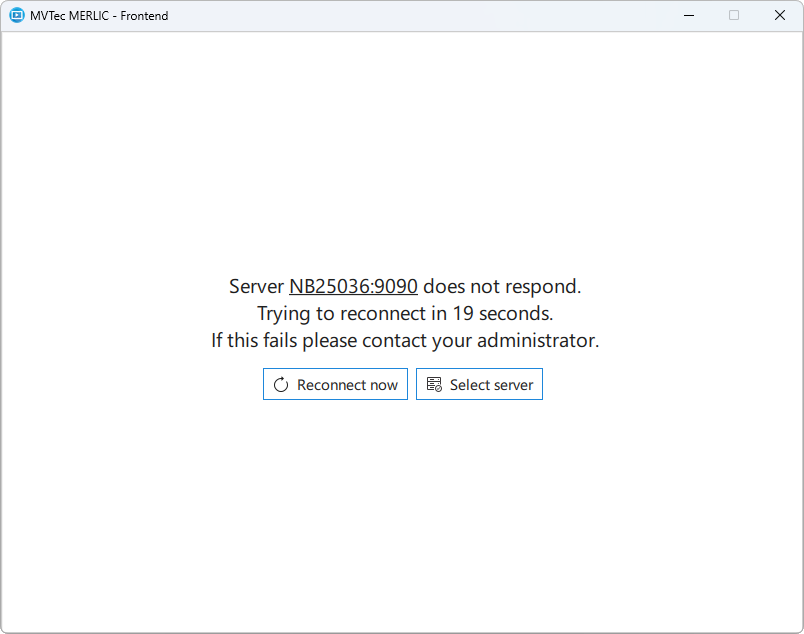
Reconnecting the Server
In some cases, the connection to the selected MERLIC server might be lost and the Frontend of the respective MERLIC Vision App is not available anymore. To re-establish the connection to the server, ensure that all prerequisites are fulfilled and try to connect again. You can either try to reconnect to the previous server with "Reconnect now", or you can use the "Select server" button to select a different server.