Configuring the Plug-in
Enabling the Configuration in the MERLIC RTE Setup
To enable the configuration of the plug-in in the "Communication" tab of the MERLIC RTE Setup, you first have to start MERLIC RTE and perform the following steps:
- Open the MERLIC RTE Setup and go to the "Communication" tab. If MERLIC RTE is not running, you can start it directly from the "Communication" tab.
-

- Make sure that the plug-in is currently not running. Otherwise, the parameters are not available for the configuration. You can see the current state of the plug-in at the respective status icon in the list of plug-in instances. If the status shows the icon
 , the plug-in is running. In this case, you have to stop it by clicking the "
 Stop plug-in" button on the bottom of the MERLIC RTE Setup. If the status shows the icon
  instead, the plug-in is currently not running.
-
The parameters of the selected MELSEC Communication plug-in are shown on the right of the "Communication" tab.
Plug-in Parameters
Parameters of this type represent general parameters for the communication plug-in that cannot be adjusted in the configuration area of the "Communication" tab. They may show the version number of the plug-in, the current parameter value for the log level, the access level of the plug-in, and the setting for the validation of the plug-in configuration. These values need to be set in different locations or with different methods, respectively.
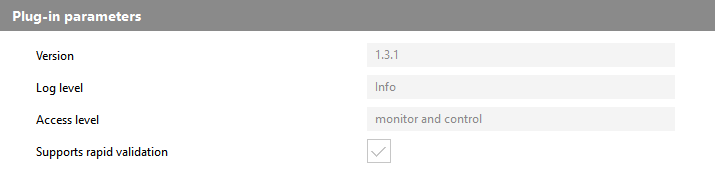
Version
This parameter shows the version number that has been defined during the plug-in implementation. It consists of a major, minor, and maintenance version. It is also shown when adding a new plug-in instance. The version is optional. Therefore, it is possible that no version number has been defined during the implementation.
Log level
This parameter shows the log level of the plug-in instance. By default, the log level is set to the log level of the respective MERLIC RTE process when adding the plug-in instance in the MERLIC RTE Setup.
Access level
This parameter shows the access level that is set for the plug-in. For the MELSEC Communication plug-in, the access level is set to "monitor and control" by default. This means that the plug-in can receive "events" and send "actions". The access level correlates with the capability that is defined in the implementation of the plug-in. The access level cannot be adjusted in the MERLIC RTE Setup.
Supports rapid validation
This parameter shows whether the plug-in supports the immediate validation of the current plug-in configuration. For this plug-in, the check box is ticked indicating that "rapid validation" is supported. This means that the configuration of the plug-in is validated with each modification of any editable parameter in the "Communication" tab of the MERLIC RTE Setup. If the plug-in does not support "rapid validation", the configuration of the plug-in is validated only when saving the configuration.
User Parameters
The "User parameters" represent the set of parameters that can be configured for the plug-in. They are displayed in different categories which can be expanded or closed.
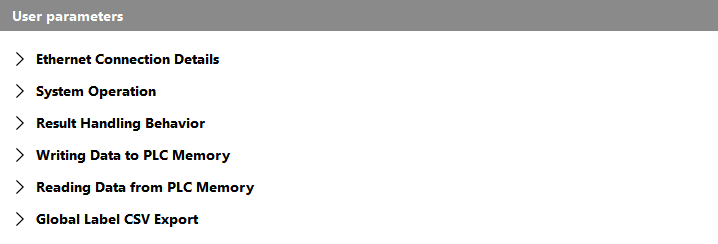
The following sections describe the parameters for each category.
- Ethernet Connection Details
- System Operation
- Result Handling Behavior
- Writing Data to PLC Memory
- Reading Data from PLC Memory
- Global Label CSV Export
Ethernet Connection Details
The following image shows an overview of the parameters with the respective default setting. A detailed description of the parameters follows the image.

IP address
This parameter defines the Internet Protocol address (IP address) of the MELSEC Communication PLC to which you want to connect. By default, it is set to "127.0.0.1". The parameter supports only Internet Protocol version 4 (IPv4) addresses. The usage of host names is thereby not supported.
Port
This parameter defines the port used for the connection.
System Operation
The parameters in this category define the settings with respect to the version of MVTec's PLC protocol and the heartbeat mode.
The following image shows an overview of the parameter with the respective default setting. A detailed description of the parameter follows the image.

Protocol version
This parameter defines the version of MVTec's PLC protocol that is used. By default, it is set to "1.1" which is the latest version. You can set the protocol version to "1.0" which corresponds to the protocol version used in previous MERLIC versions.
In contrast to the protocol version "1.0", the newer version comes with a heartbeat mode to constantly signal that the connection to MERLIC is still active. If the protocol version "1.1" is used, an additional field with the label "gMV_Heartbeat" will be available in the exported label file and reserved by the PLC. This field contains a 16 bit counter that is constantly updated by the plug-in while it is running. This allows monitoring the connection between MERLIC and the PLC and enables to handle any loss of connections due to unexpected errors by configuring the PLC program accordingly. For more information on the fields used in the PLC protocol, see Fields for the Communication with the PLC.
If you want to use existing GX Works2 or GX Works3 projects, in which MELSEC Communication plug-ins configured in MERLIC versions earlier than 5.6.0 are used, with MERLIC RTE of this MERLIC version, you either have to use the protocol version "1.0" or you have to adjust the configuration of the plug-in and your projects accordingly to the new PLC protocol.
Heartbeat interval
This parameter defines the interval for the heartbeat in milliseconds. By default, it is set to 1000 ms. This means that the field "gMV_Heartbeat" for the heartbeat counter is updated every 1000 ms. For more information on the heartbeat mode, see the section gMV_Heartbeat in Error Handling.
This parameter is available only if the protocol version is used that supports the heartbeat mode, that is, if "Protocol version" is set to "1.1". Therefore, this parameter is deactivated for configuration if the parameter "Protocol version" is set to "1.0".
Result Handling Behavior
The parameters in this category define settings with respect to the retrieval of the results. For more information on the result handling of the different modes, see Result Modes.
The following image shows an overview of the parameters with the respective default setting. A detailed description of the parameters follows the image.

Result mode
This parameter allows you to select the mode of querying the results. You can choose between "Free-running" and "Dequeue from buffer". By default, the parameter is set to "Dequeue from buffer". In the following table, we give a short description for each mode.
|
Mode |
Description |
|---|---|
|
Free-running |
In this mode, the results of a single or continuous execution are immediately written to the respective memory addresses of the PLC without any handshake mechanism. This mode is the fastest but it can also be the most error prone. Depending on the timing of both MERLIC and the PLC, it might be possible that some results get lost or overwritten before the PLC can collect them. |
|
Dequeue from buffer |
In this mode, an internal FIFO queue is used to save the incoming results after starting a single or continuous execution. If the PLC requests a result by setting the "gMV_ReqCommandCode" to 10, the first result in the buffer is written to the respective memory address of the PLC. The requested result is then immediately removed from the queue. |
Result buffer capacity
This parameter defines the size of the buffer which is used to temporarily store the results when using "Dequeue from buffer" as result mode. It represents the number of results that can be saved in the buffer. By default, it is set to 10.
This parameter is used only if "Dequeue from buffer" is set as result mode. It has no effect if "Result mode" is set to "Free-running". Therefore, it will be deactivated for configuration if the "Free-running" mode is selected.
DequeueResult command timeout
This parameter defines the timeout for the "Dequeue from buffer" mode when waiting for a new result. If the PLC requests a result and the respective result is not available yet, all other requests will be blocked until the result is available or until the specified timeout expired. By default, the timeout is set to 1000 ms.
This parameter is used only if "Dequeue from buffer" is set as result mode. It has no effect if "Result mode" is set to "Free-running". Therefore, it will be deactivated for configuration if the "Free-running" mode is selected.
Writing Data to PLC Memory
The parameters in this category define how many results can be transmitted to the PLC. You have to set the desired number for each data type separately. Make sure that the configuration fits to all MERLIC recipes you want to use, that is, to all MERLIC Vision Apps that are referenced in the recipes.
By default, no results will be transmitted to the PLC. Therefore, you first have to adjust the parameters in this category accordingly and set the desired number of results for each data type.
 How to enable the transmission of results
- If you are not sure of the required number of the results and their data type, you can check them as follows:
- Open the MERLIC Creator and load the MERLIC Vision App that is referenced in your MERLIC recipe.
- Go to the "MVApp Parameters and Results" panel and look up the data types of each MVApp result you want to transmit. Note the total number of the desired results for each data type. This is the minimum value to which the corresponding parameter in the plug-in configuration must be set so that all desired results can be transmitted.
- Check the MVApp results of all MVApps that will be used, that is, the MVApps that are referenced in the MERLIC recipes you want to use for your application.
- In the "Communication" tab of the MERLIC RTE Setup, select the desired instance of the MELSEC Communication plug-in and go to the parameters of the category "Writing Data to PLC Memory".
- For each plug-in parameter in this category, set the number of results you want to be able to transmit of the respective data type. Make sure that the value fits for all MVApps that will be used.
For example, if your MVApps may contain up to five MVApp results of data type INT, you have to set the parameter "INT (signed 16-bit integer) result allocation" to 5 or higher to ensure that the values of all INT results will by available for the PLC.
If more results of a specific data type are transmitted than specified in the plug-in configuration, not all parameters will be available because not enough device addresses were reserved on the PLC. In contrast, if fewer results are transmitted than the number specified for the respective data type, not all of the reserved devices on the PLC will be used.
Fields and allocated memory
By setting the user parameters of this category, you define how many results of each data type can be transmitted to the PLC. For each result that can be transmitted, a so-called field is reserved. A field represents a specific memory block on the PLC which is used for the respective result value. However, there are also fields for other contents or for commands, for example, for the current state or to request commands. Each field has a predefined name, for example "gMV_CurrentState".
Required Memory for the Data Types
The following table lists the required memory for each data type, that is, the number of device addresses required for a single value of the respective different data type.
|
Result data type |
Required device addresses (= 2 bytes) |
|---|---|
|
BOOL |
1 bit of a device address |
|
WORD |
1 |
|
DWORD |
2 |
|
INT |
1 |
|
DINT |
2 |
|
REAL |
2 |
|
LREAL |
4 |
|
STRING[32] |
16 |
Example
The following section describes an example how to configure the plug-in to enable the transmission of two results to the PLC and shows which fields are allocated on the PLC.
If your MVApp contains exactly two MVApp results of data type INT and you want to allow the transmission of both of these results, you have set the respective user parameter in the plug-in configuration. As the results are of data type INT, you have to set the parameter "INT (signed 16-bit integer) result allocation". For this example, the parameter must be set to at least 2 to ensure that the PLC will be able to query up to two results of data type INT.
After saving the configuration of the plug-in, the corresponding set of fields can be exported as specified in the parameter category "Export Symbols". When implementing the program for the PLC, the exported file serves as input which fields and memory blocks are required for the communication. For our example configuration, the plug-in will allocate the following three fields:
|
Fields |
Description |
|---|---|
|
gMV_ResultUseArray_INT |
This field indicates whether an INT result is available to be queried. The field which indicates whether results are available always precedes the fields for the result values. |
|
gMV_Result_INT_0 |
This field is used for the value of the INT result with index 0. The appended number corresponds to the index of the result in the overview of the MVApp results within the MERLIC Creator. Thus, the INT result with index 0 represents the first INT result in the MVApp results overview. |
|
gMV_Result_INT_1 |
This field is used for the value of the INT result with index 1. The appended number corresponds to the index of the result in the overview of the MVApp results within the MERLIC Creator. Thus, the INT result with index 1 represents the second INT result in the MVApp results overview. |
If only one INT result is transmitted, not all of the reserved registers on the PLC will be used. However, if more than two results of data type INT are transmitted, for example, because the MVApp of the prepared recipe contains more than two INT results, only the first two results will be available to be queried by the PLC because the plug-in reserved only the register addresses for two INT results.
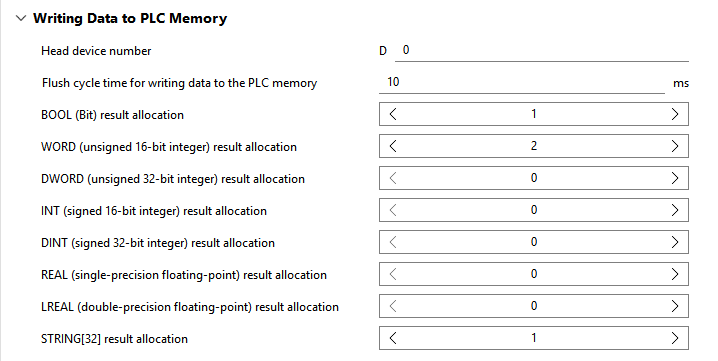
The following image shows an overview of the parameters. A detailed description of the parameters follows the image.
Head device number
This parameter defines the first device address of the block that is reserved on the PLC for all values that are written into the protocol by the plug-in and read by the PLC, for example, the current state and result values.
By default, it is set to 0 which corresponds to D0.
Flush cycle time for writing data to the PLC memory
This parameter defines the interval at which the plug-in attempts to write data to the PLC memory.
By default, it is set to 10 ms, which means that the plug-in attempts to write the data to the PLC every
BOOL (Bit) result allocation
This parameter defines the number of Boolean results that can be transmitted to the PLC. For example, if you want to transmit up to five Boolean results, set the parameter to 5 or higher.
By default, the parameter is set to 0 which means that no Boolean result will be transmitted.
Parameters of this data type require exactly one bit. Therefore, exactly one bit of a device address is mapped to the field of a Boolean result provided that up to 16 results are selected. The individual results within a given device are addressed using a hexadecimal digit, for example, D30.0, D30.1, ..., D30.f. If more than 16 Boolean results are returned, further device addresses are mapped to provide a field for each result.
WORD (unsigned 16-bit integer) result allocation
This parameter defines the number of WORD results that can be transmitted to the PLC. For example, if you want to transmit up to five WORD results, set the parameter to 5 or higher.
By default, the parameter is set to 0 which means that no WORD result will be transmitted.
Parameters of this data type require exactly 16 bits which correspond to exactly one device. Therefore, the address of a whole device will be mapped, for example, D31.
DWORD (unsigned 32-bit integer) result allocation
This parameter defines the number of DWORD results that can be transmitted to the PLC. For example, if you want to transmit up to five DWORD results, set the parameter to 5 or higher.
By default, the parameter is set to 0 which means that no DWORD result will be transmitted.
Parameters of this data type require exactly 32 bits which corresponds to exactly two devices. Therefore, two devices are reserved but only the address of the first will be mapped, for example, D32 if the addresses D32 and D33 are used.
INT (signed 16-bit integer) result allocation
This parameter defines the number of INT results that can be transmitted to the PLC. For example, if you want to transmit up to five INT results, set the parameter to 5 or higher.
By default, the parameter is set to 0 which means that no INT result will be transmitted.
Parameters of this data type require exactly 16 bits which correspond to exactly one device. Therefore, the address of a whole device will be mapped, for example, D34.
DINT (signed 32-bit integer) result allocation
This parameter defines the number of DINT results that can be transmitted to the PLC. For example, if you want to transmit up to five DINT results, set the parameter to 5 or higher.
By default, the parameter is set to 0 which means that no DINT result will be transmitted.
Parameters of this data type require exactly 32 bits which correspond to exactly two devices. Therefore, two devices are reserved but only the address of the first will be mapped, for example, D35 if the addresses D35 and D36 are used.
REAL (single-precision floating-point) result allocation
This parameter defines the number of REAL results that can be transmitted to the PLC. For example, if you want to transmit up to five REAL results, set the parameter to 5 or higher.
By default, the parameter is set to 0 which means that no REAL result will be transmitted.
Parameters of this data type require exactly 32 bits which correspond to exactly two devices. Therefore, two devices are reserved but only the address of the first will be mapped, for example, D37 if the addresses D37 and D38 are used.
LREAL (double-precision floating-point) result allocation
This parameter defines the number of LREAL results that can be transmitted to the PLC. For example, if you want to transmit up to five LREAL results, set the parameter to 5 or higher.
By default, the parameter is set to 0 which means that no LREAL result will be transmitted.
Parameters of this data type require exactly 64 bits which correspond to exactly four devices. Therefore, four devices are reserved but only the address of the first will be mapped, for example, D39 if the addresses D39 to D42 are used.
STRING[32] result allocation
This parameter defines the number of STRING[32] results that can be transmitted to the PLC. For example, if you want to transmit up to five STRING[32] results, set the parameter to 5 or higher.
By default, the parameter is set to 0 which means that no STRING[32] result will be transmitted.
Parameters of this data type require exactly 32 bytes (256 bits) which corresponds to exactly 16 devices. Therefore, 16 devices are reserved but only the address of the first will be mapped, for example, D43 if the addresses D43 to D58 are used.
Reading Data from PLC Memory
The parameters in this category define how many iteration parameters can be provided per data type to the PLC. An iteration parameter represents a parameter that serves as argument for the execution of the MVApp to override the value of the corresponding MVApp parameter that is given in the prepared recipe. This allows you to run the MVApp with other input values without the need to change the recipe. Thus, the user parameters in this category define how many parameter values per data type can be overridden by the PLC for the execution.
By default, no iteration parameters will be available for configuration by the PLC. Therefore, you first have to adjust the parameters in this category accordingly and set the desired number of iteration parameters for each data type.
How to enable the use of iteration parameters
If you want to allow the PLC to override the value of a specific MVApp parameter for the execution, you have to ensure that the user parameter for the respective data type is set accordingly.
- If you are not sure of the required number of the iteration parameters and their data type, you can check them as follows:
- Open the MERLIC Creator and load the MERLIC Vision App that is referenced in your MERLIC recipe.
- Go to the "MVApp Parameters and Results" panel and look up the data types of each MVApp parameter you want to set via the PLC. Note the total number of the desired iteration parameters for each data type. This is the minimum value to which the corresponding parameter in the plug-in configuration must be set so that all desired iteration parameters can be set via the PLC.
- Check the MVApp parameters of all MVApps that will be used, that is, the MVApps that are referenced in the MERLIC recipes you want to use for your application.
- In the "Communication" tab of the MERLIC RTE Setup, select the desired instance of the MELSEC Communication plug-in and go to the parameters of the category "Reading Data from PLC Memory".
- For each plug-in parameter in this category, set the number of iteration parameters you want to be able to override. Make sure that the value fits for all MVApps that will be used.
For example, if your MVApps may contain up to three MVApp parameters of data type INT, you have to set the parameter "INT (signed 16-bit integer) iteration parameter allocation" to at least 3 to ensure that all MVApp parameters of this data type can be adjusted via the PLC.
The plug-in configuration only defines how many iteration parameters will be available for the PLC to override the respective MVApp parameters in the execution. However, the specified iteration parameters don't have to be used. The PLC may also request a single or continuous execution without using an iteration parameter. In this case, the MVApp will be executed with the values defined in the respective recipe.
When specifying iteration parameters to override parameter values in the recipe, the PLC needs to consider some requirements. The number of specified parameter values need to correspond to the number of values defined in the recipe file. In addition, their data type must be suitable to enable a lossless conversion into the data type of the respective parameter value in the recipe. If these conditions are not met, the whole set of iteration parameters is discarded and the recipe is executed with the default values instead. In this case, a warning will be emitted, also on the "gMV_ErrorCode" and "gMV_ErrorCause" fields. For more information, see the description of the corresponding rules stated for the parameter "MV_PARAM_START_PARAMS" in Available Actions in the Communication Plug-in Development Manual.
Fields and allocated memory
By setting the user parameters of this category, you define how many iteration parameters of each data type can be set by the PLC. For each iteration parameter that is available for configuration by the PLC, a so-called field is reserved. This means that the required memory needs to be allocated for the iteration parameters. You can do this by setting the value of each user parameter in this category to the number of iteration parameters you want to make available for the PLC for the respective data type. For more information on the available fields, see Fields for the Communication with the PLC.
For more information on the required memory for each data type, see the section Fields and allocated memory in the description of the category "Writing Data to PLC Memory".
Example
The following section describes an example how to configure the plug-in to allow overriding the iteration parameters by the PLC and it shows which fields are allocated on the PLC.
If your recipe contains two MVApp parameters of data type INT and one MVApp parameter of data type STRING_80, and you want to enable the PLC to override the values of these parameters for a single or continuous execution, you have to set the following parameters:
|
User parameter |
Value |
|---|---|
|
INT (signed 16-bit integer) iteration parameter allocation |
2 |
|
STRING[32] iteration parameter allocation |
1 |
It is also possible to set higher values even if your current recipe only contains two INT parameters and one STRING_80 parameter. However, for this example we assume that the values in the plug-in configuration are set as described in the table above.
After saving the configuration of the plug-in, the corresponding set of fields can be exported as specified in the parameter category "Export Symbols". When implementing the program for the PLC, the exported file serves as input which fields and memory blocks are required for the communication. For our example configuration, the plug-in will allocate the following fields:
|
Allocated field |
Description |
|---|---|
|
gMV_ItParamUseArray_INT |
This field will serve as indicator whether the recipe parameters of data type INT shall be overridden for the next single or continuous execution by the value defined in "gMV_ItParam_INT_0" and "gMV_ItParam_INT_1". |
|
gMV_ItParamUseArray_STRING32 |
This field will serve as indicator whether the recipe parameter of data type STRING_80 will be overridden for the next single or continuous execution by the value defined in "gMV_ItParam_STRING32_0". |
|
gMV_ItParam_INT_0 |
This field will be provided to define the new value for the MVApp parameter of data type INT and index 0, that is, for the first INT parameter in the recipe. The number that is added as suffix indicates the index of the recipe parameter. In this example, it refers to the first recipe parameter of data type INT. The list of recipe parameters and the respective index number is also visible in the overview of the MVApp parameters within the MERLIC Creator. |
|
gMV_ItParam_INT_1 |
This field will be provided to define the new value for the MVApp parameter of data type INT and index 1, that is, for the second INT parameter in the recipe. As indicated by the suffix 1, this field refers to the second recipe parameter of data type INT. |
|
gMV_ItParam_STRING32_0 |
This field will be provided to define the new value for the MVApp parameter of data type STRING_80 and index 0, that is, for the STRING_80 parameter in the recipe. As indicated by the suffix 0, this field refers to the first recipe parameter of data type STRING_80. |
The new fields can then be used to specify parameter values for the execution of the MVApp that is referenced in the prepared recipe.
For our example, we assume that the recipe with two INT parameters and one STRING_80 parameter is prepared. To override the parameters for the next execution, the PLC has to set the desired values for the parameters into the respective fields and specify that all three parameters values should be used for the next "StartSingleJob" or "StartContinuous" command. This means, the PLC has to set the values for the following fields:
|
Field |
Description |
|---|---|
|
gMV_ItParamUseArray_INT |
The first two bits in this array must be set to 1 |
|
gMV_ItParamUseArray_STRING32 |
The value for this field must be set to 1 (or alternatively to TRUE). This indicates that the value in "gMV_ItParam_STRING32_0" should be used for the next execution. |
|
gMV_ItParam_INT_0 |
This field must be set to the integer value that shall be used for the first INT parameter instead of the value defined in the recipe. |
|
gMV_ItParam_INT_1 |
This field must be set to the integer value that shall be used for the second INT parameter instead of the value defined in the recipe. |
|
gMV_ItParam_STRING32_0 |
The sequence of WORDS in these fields must be set to the string that shall be used for the STRING_80 parameter instead of the value defined in the recipe. |
When the new "StartSingleJob" or "StartContinuous" command is requested by the PLC, the plug-in will use the specified values of the iteration parameters for the next execution. The recipe values will be overwritten with each "StartSingleJob" and "StartContinuous" command as long as the fields "gMV_ItParamUseArray_INT" and "gMV_ItParamUseArray_STRING32" are set as described above, that is, until their values are reset to 0. If no iteration parameters are set to "in use", the default value defined in the recipe are used again.
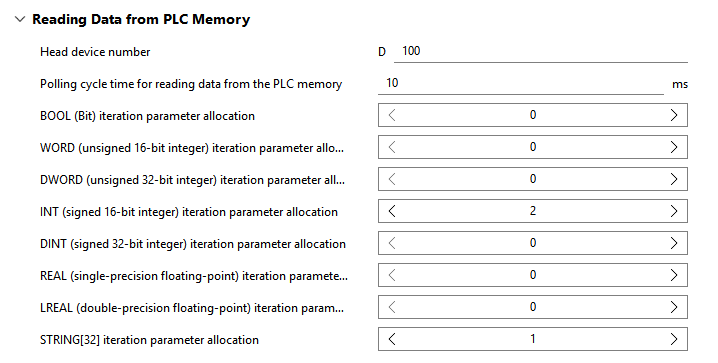
The following image shows an overview of the parameters. A detailed description of the parameters follows the image.
Head device number
This parameter defines the first device address of the block that is reserved on the PLC. This block includes all values that are written into the protocol by the PLC and read by the plug-in, for example, requested commands and values of iteration parameters. By default, it is set to 100 which correspond to D100.
Alternatively, you can also set the parameter to a large number to minimize the chances of a memory overlap.
Polling cycle time for reading data from the PLC memory
This parameter defines the interval at which the plug-in attempts to read the complete memory from the PLC memory section.
By default, it is set to 10 ms, which means that the plug-in attempts to read the memory every
BOOL (Bit) iteration parameter allocation
This parameter defines the number of iteration parameters of data type Boolean that can be transmitted from the PLC to MERLIC. For example, if you want to allow the PLC to override the Boolean values of up to five MVApp parameters defined in the recipe, set the parameter to 5.
By default, the parameter is set to 0 which means that no field will be added for any parameters of this data type.
Parameters of this data type require exactly 1 bit. Therefore, exactly one bit of a device address is mapped to the field of a Boolean iteration parameter. The individual iteration parameters within a given device are addressed using a hexadecimal digit, for example, D112.0, D112.1, ..., D112.f.
In addition, another field will be added: "gMV_ItParamUseArray_BOOL". This field is used by the PLC to indicate whether the provided parameter values in the recipe shall be overridden for the next execution by the values defined in the fields of the respective iteration parameters.
For each available iteration parameter of this data type, the PLC needs to define bit by bit whether it should be used for the execution. For example, if you set this parameter to 2 and want to use both Boolean parameters in the next execution, the PLC needs to set the value of the "gMV_ItParamUseArray_BOOL" field to
WORD (unsigned 16-bit integer) iteration parameter allocation
This parameter defines the number of iteration parameters of data type WORD that can be transmitted from the PLC to MERLIC. For example, if you want to allow the PLC to override the WORD values of up to five MVApp parameters defined in the recipe, set the parameter to 5.
By default, the parameter is set to 0 which means that no field will be added for any parameters of this data type.
Parameters of this data type require exactly 16 bits which correspond to exactly one device. Therefore, the address of a whole device will be mapped, for example, D113.
In addition, another field will be added: "gMV_ItParamUseArray_WORD". This field is used by the PLC to indicate whether the provided parameter values in the recipe shall be overridden for the next execution by the values defined in the fields of the respective iteration parameters.
For each available iteration parameter of this data type, the PLC needs to define bit by bit whether it should be used for the execution. For example, if you set this parameter to 2 and want to use both WORD parameters in the next execution, the PLC needs to set the value of the "gMV_ItParamUseArray_WORD" field to
DWORD (unsigned 32-bit integer) iteration parameter allocation
This parameter defines the number of iteration parameters of data type DWORD that can be transmitted from the PLC to MERLIC. For example, if you want to allow the PLC to override the DWORD values of up to five MVApp parameters defined in the recipe, set the parameter to 5.
By default, the parameter is set to 0 which means that no field will be added for any parameters of this data type.
Parameters of this data type require exactly 32 bits which correspond to exactly two devices. Therefore, two devices are reserved but only the address of the first will be mapped, for example, D114 if the addresses D114 and D115 are used.
In addition, another field will be added: "gMV_ItParamUseArray_DWORD". This field is used by the PLC to indicate whether the provided parameter values in the recipe shall be overridden for the next execution by the values defined in the fields of the respective iteration parameters.
For each available iteration parameter of this data type, the PLC needs to define bit by bit whether it should be used for the execution. For example, if you set this parameter to 2 and want to use both DWORD parameters in the next execution, the PLC needs to set the value of the "gMV_ItParamUseArray_DWORD" field to
INT (signed 16-bit integer) iteration parameter allocation
This parameter defines the number of iteration parameters of data type INT that can be transmitted from the PLC to MERLIC. For example, if you want to allow the PLC to override the INT values of up to five MVApp parameters defined in the recipe, set the parameter to 5.
By default, the parameter is set to 0 which means that no field will be added for any parameters of this data type.
Parameters of this data type require exactly 16 bits which correspond to exactly one device. Therefore, the address of a whole device will be mapped, for example, D116.
In addition, another field will be added: "gMV_ItParamUseArray_INT". This field is used by the PLC to indicate whether the provided parameter values in the recipe shall be overridden for the next execution by the values defined in the fields of the respective iteration parameters.
For each available iteration parameter of this data type, the PLC needs to define bit by bit whether it should be used for the execution. For example, if you set this parameter to 2 and want to use both INT parameters in the next execution, the PLC needs to set the value of the "gMV_ItParamUseArray_INT" field to
DINT (signed 32-bit integer) iteration parameter allocation
This parameter defines the number of iteration parameters of data type DINT that can be transmitted from the PLC to MERLIC. For example, if you want to allow the PLC to override the DINT values of up to five MVApp parameters defined in the recipe, set the parameter to 5.
By default, the parameter is set to 0 which means that no field will be added for any parameters of this data type.
Parameters of this data type require exactly 32 bits which correspond to exactly two devices. Therefore, two devices are reserved but only the address of the first will be mapped, for example, D117 if the addresses D117 and D118 are used.
In addition, another field will be added: "gMV_ItParamUseArray_DINT". This field is used by the PLC to indicate whether the provided parameter values in the recipe shall be overridden for the next execution by the values defined in the fields of the respective iteration parameters.
For each available iteration parameter of this data type, the PLC needs to define bit by bit whether it should be used for the execution. For example, if you set this parameter to 2 and want to use both DINT parameters in the next execution, the PLC needs to set the value of the "gMV_ItParamUseArray_DINT" field to
REAL (single-precision floating-point) iteration parameter allocation
This parameter defines the number of iteration parameters of data type REAL that can be transmitted from the PLC to MERLIC. For example, if you want to allow the PLC to override the REAL values of up to five MVApp parameters defined in the recipe, set the parameter to 5.
By default, the parameter is set to 0 which means that no field will be added for any parameters of this data type.
Parameters of this data type require exactly 32 bits which correspond to exactly two devices. Therefore, two devices are reserved but only the address of the first will be mapped, for example, D119 if the addresses D119 and D120 are used.
In addition, another field will be added: "gMV_ItParamUseArray_REAL". This field is used by the PLC to indicate whether the provided parameter values in the recipe shall be overridden for the next execution by the values defined in the fields of the respective iteration parameters.
For each available iteration parameter of this data type, the PLC needs to define bit by bit whether it should be used for the execution. For example, if you set this parameter to 2 and want to use both REAL parameters in the next execution, the PLC needs to set the value of the "gMV_ItParamUseArray_REAL" field to
LREAL (double-precision floating-point) iteration parameter allocation
This parameter defines the number of iteration parameters of data type LREAL that can be transmitted from the PLC to MERLIC. For example, if you want to allow the PLC to override the LREAL values of up to five MVApp parameters defined in the recipe, set the parameter to 5.
By default, the parameter is set to 0 which means that no field will be added for any parameters of this data type.
Parameters of this data type require exactly 64 bits which correspond to exactly four devices. Therefore, four devices are reserved but only the address of the first will be mapped, for example, D121 if the addresses D121 to D124 are used.
In addition, another field will be added: "gMV_ItParamUseArray_LREAL". This field is used by the PLC to indicate whether the provided parameter values in the recipe shall be overridden for the next execution by the values defined in the fields of the respective iteration parameters.
For each available iteration parameter of this data type, the PLC needs to define bit by bit whether it should be used for the execution. For example, if you set this parameter to 2 and want to use both LREAL parameters in the next execution, the PLC needs to set the value of the "gMV_ItParamUseArray_LREAL" field to
STRING[32] iteration parameter allocation
This parameter defines the number of iteration parameters of data type STRING[32] that can be transmitted from the PLC to MERLIC. For example, if you want to allow the PLC to override the STRING[32] values of up to five MVApp parameters defined in the recipe, set the parameter to 5.
By default, the parameter is set to 0 which means that no field will be added for any parameters of this data type.
Parameters of this data type require exactly 32 bytes (256 bits) which corresponds to exactly 16 devices. Therefore, 16 devices are reserved but only the address of the first will be mapped, for example, D125 if the addresses D125 to D140 are used.
In addition, another field will be added: "gMV_ItParamUseArray_STRING32". This field is used by the PLC to indicate whether the provided parameter values in the recipe shall be overridden for the next execution by the values defined in the fields of the respective iteration parameters.
For each available iteration parameter of this data type, the PLC needs to define bit by bit whether it should be used for the execution. For example, if you set this parameter to 2 and want to use both STRING[32] parameters in the next execution, the PLC needs to set the value of the "gMV_ItParamUseArray_STRING32" field to
Global Label CSV Export
The parameters in this category define the location and name of the file that is exported when starting the plug-in. The file is based on the configuration of the plug-in and contains the
The file is formatted as a CSV file (comma-separated values file) and can be imported to the project of the PLC program.
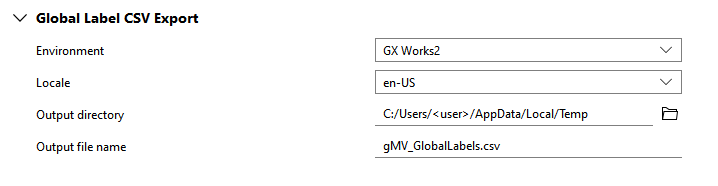
The following image shows an overview of the parameters with the respective default setting. A detailed description of the parameters follows the image.
Environment
This parameter defines the application for which the labels are exported. You can select between the GX Works versions listed in the table below. The exported "Global Label" file will be formatted as required by the selected application. By default, it is set to "GX Works2". Make sure to select the correct application. Otherwise, an error might occur when importing the CSV file into the project of your GX Works version.
|
Value |
Description |
|---|---|
|
GX Works2 |
The exported "Global Label" file will be formatted as required by GX Works2. |
|
GX Works3 |
The exported "Global Label" file will be formatted as required by GX Works3. |
Locale
This parameter defines the language for the export of the "Global Label" file. To be more precise, it determines the language of the headings in the exported file. Currently, you can choose between the settings listed in the table below. By default, it is set to "en-US".
|
Value |
Description |
|---|---|
|
en-US |
English (United States) |
|
ja-JP |
Japanese (Japan) |
Make sure to select the correct language to avoid errors when importing the CSV file in GX Works. If you are using GX Works in English, you have to select "en-US" and if you are the Japanese version, you have to select "ja-JP".
Output directory
This parameter defines the directory in which the file will be saved. You can select the directory from the file system via the  button (on local systems) or you can type the path directly into the text field. By default, it is set to "%LOCALAPPDATA%/Temp" on Windows systems and to "/tmp" on Linux systems.
Output file name
This parameter defines the name of the exported file. You can change the name directly in the text field. By default, it is set to "gMV_GlobalLabels.csv".