Configuring Camera Devices
To enable the configuration options for an image source representing a camera device, you have to activate the image source configuration that contains the respective image source. Only then it is possible to acquire images, to check them in the image preview, and to adjust the settings of the camera device. For more information about the activation, see the topic Activating the Configuration
Selecting a Camera Device for further Configuration
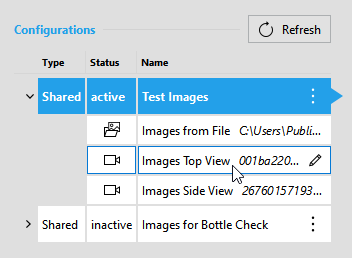
To start the configuration of a camera device, select the respective image source from the active configuration on the left.
- Expand the active image source configuration to display the list of image sources.
- Click on the desired image source to select it for the configuration. You can recognize camera devices by the icon
 .
.
The respective details of the selected camera device will be loaded and shown on the right of the image source list. You can then use the image preview area to check the settings of the camera parameters that are provided in the "Parameters" sections in real time and to save snapshots of your camera on your system. In addition, you can look up further information on the camera device in the "Info" area below the image preview.
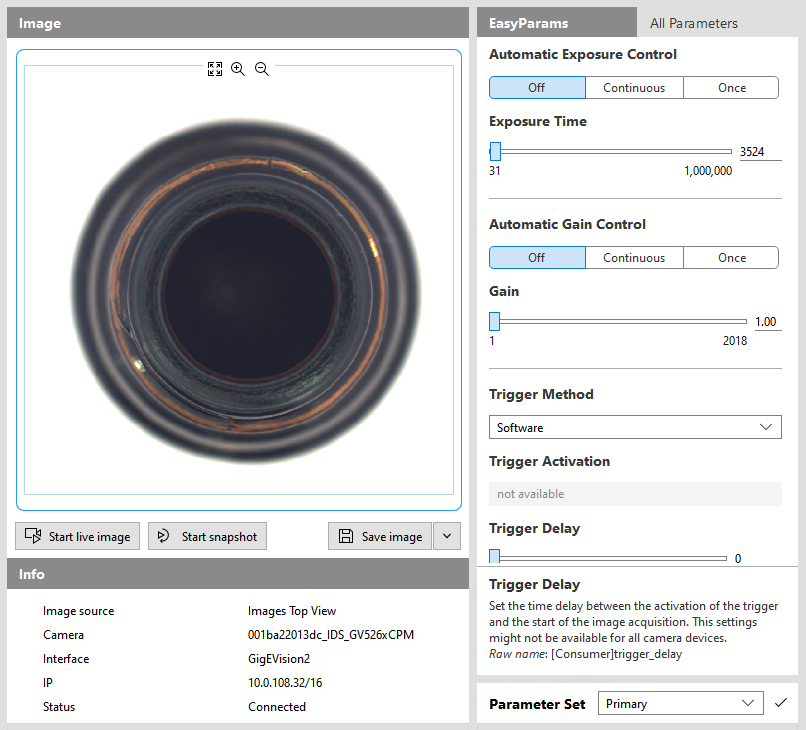
After selecting a new or different image source, it might be necessary to update the image view via the " Start snapshot" button on the bottom of the image preview.
In the following, you can get information on the image preview, where to find further information of the selected camera, and how to reconnect a camera. For more information about the "Parameters" section providing the camera parameters and the different options to adjust the parameter settings, see the topic Adjusting Camera Parameters.
Checking the Images in the Image Preview
You can use the image preview to acquire images from your camera device and to check the current parameter settings of the camera. You can configure the camera in real time, zoom in and out of the image to facilitate the configuration of the settings, for example, the camera focus, and also save the currently displayed image.
The image preview does not represent the exact image that will be acquired by MERLIC and used within your application. For more information about how to use configured image sources in a MERLIC Vision App, see the topic Using Image Sources in MVApps.
Acquiring Images for the Preview
You can acquire images in two different ways: in a live mode or by taking snapshots of single images.
Acquiring Images in Live Mode
In the live mode, the images are acquired continuously from the camera.
To start the live mode, click on the button " Start live image". To stop the live mode, use the "
 Stop live image" button.
The live mode depends on the trigger you have chosen for your camera device.
- Hardware trigger: Make sure that your hardware is triggering the image acquisition for the live mode to work.
- Software trigger: If you are configuring your trigger in the "All Parameters" tab, make sure that the parameter "Trigger Mode" is set to "On" for the live mode to work.
- Off: The live mode works, but a visible delay of the images may occur.
For more information about trigger configuration, see the topic Configuring Triggers for the Image Acquisition.
Acquiring a Single Image
To acquire only a single image from the camera, click on the button " Start snapshot". To stop the request for a single image, for example, in case of a timeout, use the " Stop snapshot" button.
Zooming Images
You can adjust the image section of the images you are acquiring for the image preview. This is useful, for example, if you want to make sure that certain parts of the acquired image are in focus. You can zoom an image in different ways:
- Drawing the area to be zoomed into the image
- Using the icons in the zooming toolbar
- Using keyboard shortcuts
This feature is only meant for the configuration in the Image Source Manager. The images that MERLIC acquires will remain unzoomed. To zoom the images that are acquired to be used in your MVApp, you can use the MERLIC tool Zoom Image.
Drawing the Area to be Zoomed into the Image
To zoom a specific part of an image, right-click into the image and draw a rectangle over the area you wish to zoom. When using the right-click while hovering over the image, your cursor changes into the  icon. The right-click selection overrides the aspect ratio of the image. The selected section will be stretched to fit the size of the image display in the "Image Sources" tab.
Using the Icons Zooming Toolbar
You can use the icons in the zooming toolbar to zoom in and out of an image at a specific position without changing the aspect ratio. When using the  and
and  icons, the position of the mouse cursor determines where the image is zoomed.
|
Icon |
Description |
|---|---|
|
|
Reset the image to its original size. |
|
|
Activate the zoom in mode by clicking the The icon is grayed out when the image cannot be zoomed in any further. |
|
|
Activate the zoom out mode by clicking the The icon is grayed out when the image cannot be zoomed out any further. |

Using Keyboard Shortcuts for Zooming
When using the keyboard shortcuts to zoom the image, it is zoomed in the center of the image without changing the aspect ratio.
|
Shortcut |
Description |
|---|---|
|
Ctrl + 0 |
Reset the image to its original size. |
|
Ctrl + + |
Zoom into the image. |
|
Ctrl + - |
Zoom out of the image. If the image already fits the graphic window, this shortcut is disabled. |
|
Ctrl + mouse wheel |
Zoom into and out of the image at the position of the mouse cursor. |
|
Ctrl + left click |
Move around within the zoomed image. Using this shortcut, your cursor changes into the |
 icon when hovering over the image display.
Saving Snapshots
You can save snapshots taken from the camera device to any location on your computer. This allows you use the saved image files instead of live images from the camera during the creation, configuration, and testing of the MVApp. If the MVApp is ready for productive use, you can change the image source to use the camera device for the image acquisition. You can keep the saved images on the system that is used to develop the MVApp independent from the system on which the camera device is connected.
Defining the Location and File Name
- Click on the button with the small arrow next to the button "
 Save image". For small window sizes, the button only shows the icon without text.
 - Enter the path and file name into the input field or click on the
 icon to define the location and file name in the file selection dialog. You can save the image either in PNG format or in JPEG format. Other file formats are currently not supported. In the next step, you can save the image in the defined location.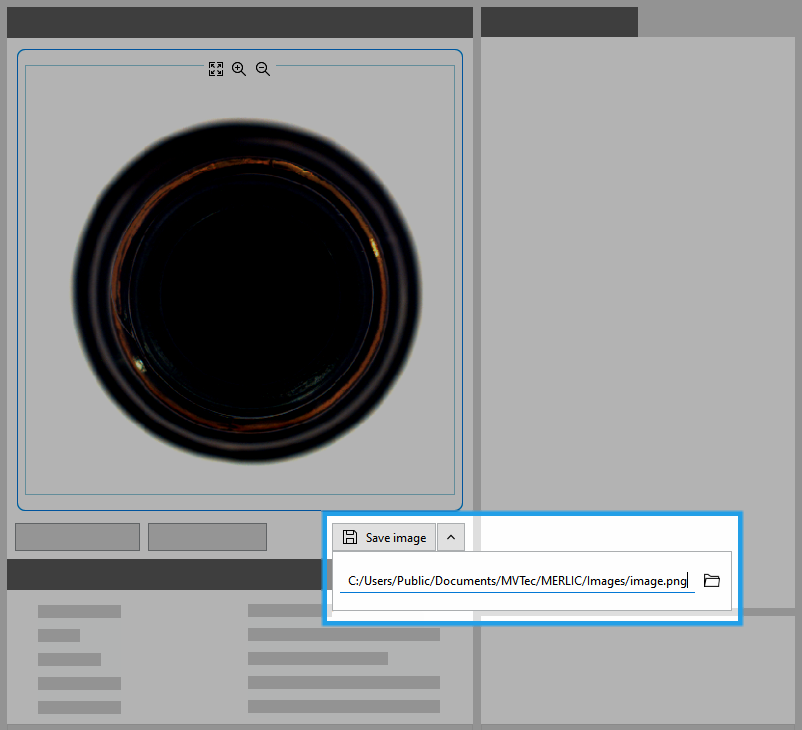
Saving the Image
Click on the button "Save image" to save the image to the predefined location.
If multiple images are saved without changing the file name and location, an index number will be added as a suffix to the file name, for example, "image_1.png" and "image_2.png". If no file name and no file path has been defined yet, the file selection dialog will be opened.
You can also save images when you are acquiring images for the preview in the live mode. Then, the image that was acquired at the time when you clicked on the "Save image" will be saved.
Looking Up Further Information
You can get further information on the selected image source beneath the image preview in the "Info" area.
|
Info |
Description |
|---|---|
|
Image source |
Name of the image source |
|
Camera |
Name of the camera |
|
Interface |
Image acquisition interface |
|
IP |
IP address of the camera (only if the configuration is active) |
|
Status |
Current status of the camera |
Reconnecting the Camera Device
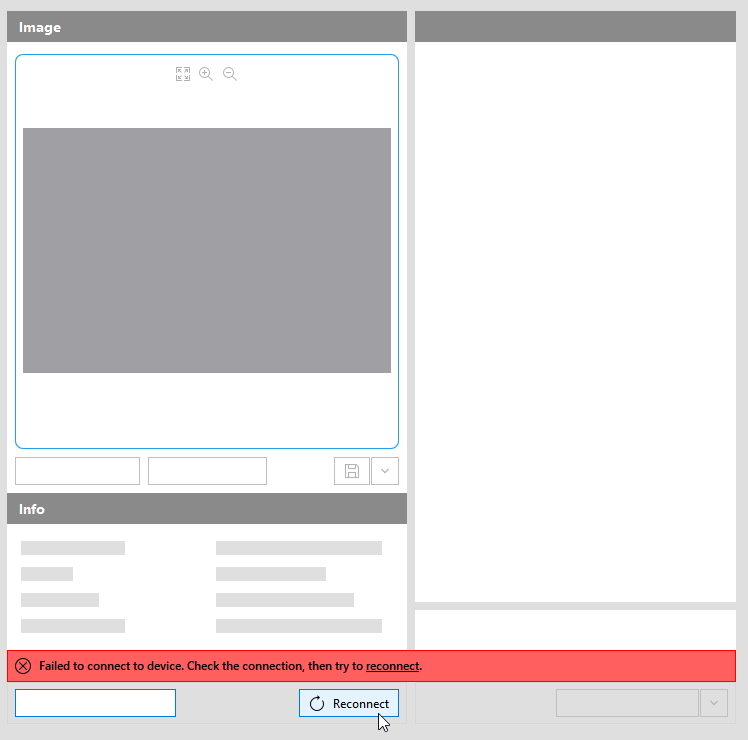
In some cases, the camera device might not be connected anymore and therefore the camera parameters are not available and no images can be acquired. Instead, an error image is shown. In this case, you can try to reconnect to the camera with the button "Reconnect" on the bottom of the image preview.