MVTec HALCON’s deep learning helps Panasonic Energy to propel automotive battery production

Automotive | Battery Production | HALCON | Deep Learning | Inspection

Panasonic Energy manufactures automotive batteries, for which demand is increasing worldwide, at multiple sites in Japan and North America. The company recently implemented MVTec HALCON’s deep learning technologies on a large scale at its Kansas plant in the U.S. to improve yield and quality in the cylindrical lithium-ion battery manufacturing process.

HALCON’s deep learning introduced for advanced battery inspection

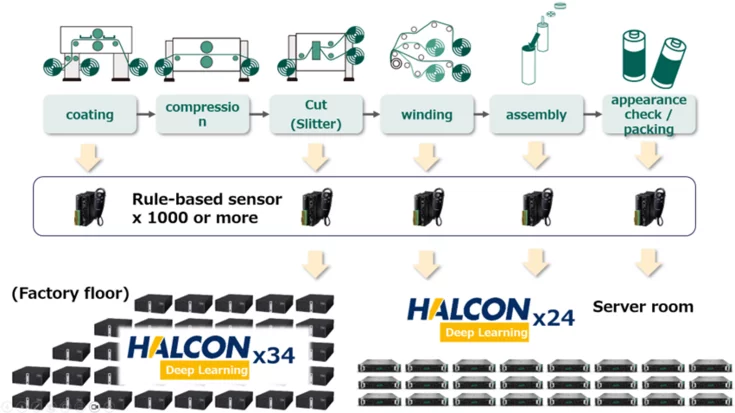
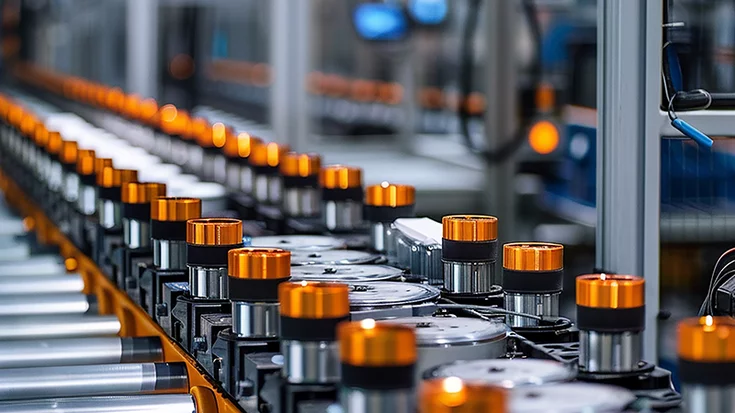
Cylindrical lithium-ion batteries are produced through the processes shown in the figure below. The first step is to coat the metal thin film with slurry, followed by compressing the coated electrode plates, slitting, winding, cell assembly, and finally visual inspection and packaging.

At the Kansas plant, deep learning image processing has been introduced for inspection at each step following the slitting process. Combined with rule-based machine vision methods, it prevents defective products from escaping with a high degree of accuracy.

Zero defective outflow achieved while halving the number of over-detections

The inspection covers a wide range of inspection topics, but one example is laser weld mark inspection of electrode tabs in the assembly process, as seen in the picture.

The "fine vertical scratches" and "lateral scratches caused by jigs" on the left are good products, while the "fiber waste adhesion" and "welding spattering" on the right are defective products. Although it is possible to identify these defects if a human visually checks the images, it is difficult to identify them with conventional rule-based inspection machines, which are set to over-detect them.

The solution to this problem was provided by MVTec

Using its machine vision software HALCON, a verification system was set up, which combines the conventional rule-based inspection with a deep-learning-based judgment function. This was tested at a domestic plant and resulted in a 57.3% reduction in the number of over-detected discharges. The verification results proved the high reliability of the deep learning inspection with HALCON, and the decision was made to fully implement the system at the Kansas plant.

This success story was kindly provided by Panasonic Energy Co. All images are courtesy of Panasonic Energy Co.