MVTEC HALCON

Circuit Breakers – Sensata

Sensata Technologies uses HALCON to precisely determine the "snap point" of bimetallic thermal protectors. A GigE camera captures the movement of the bimetal disks in a special oven. HALCON algorithms filter the images, locate the disks, and detect the characteristic "snap" movement. The system enables accurate temperature measurement and provides data for quality control.
HALCON
Electric Components
Glass, Metal, Paper, Foil & Printing
Blob Analysis
Filtering
Matching
Measuring

Hair dryers can consume up to 1875 W of power to produce hot-air flow up to 140°F, or the maximum temperature the typical human scalp can handle without burning. That's a lot of electrical energy, producing a lot of heat. A bimetallic disk, measuring about 5 × 10 mm, forms the heart of a thermal protector switch that breaks the electrical circuit if the internal temperature exceeds a safe level.

Sensata Technologies manufactures bimetal disks and thermal protector switches for many products, including coffee machines and electric motors. As a bimetal disk is heated, the two metal layers expand at different rates. Eventually, the disk will bend enough to break a physical connection with a nearby electrode, cutting power to the circuit. After the device cools sufficiently, the disk returns to its original shape, and the circuit can be energized.

Until recently, Sensata had used either oil baths or heating ovens with thermal imaging systems to heat the disks and measure the "snap" level, or the temperature at which the disk makes a relatively fast, hard movement. Unfortunately, environmental concerns and rising petroleum costs have made oil baths less attractive as a heating/testing medium, while the highly reflective bimetal disks must be coated before thermal imaging can make accurate measurements.

In an effort to alleviate these problems, Sensata turned to machine-vision specialist TCPM to develop a system using traditional visible-light sensors, special ovens, and a generic PC running a Visual Basic front end and MVTec Software HALCON image-processing algorithms to test up to 1024 bimetal disks per hour with greater accuracy and speed than previous test methods.
Snap off the power

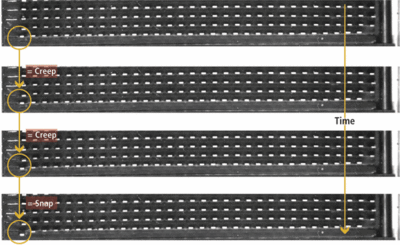
Bimetal disks are made by bonding two different metal sheets together and then stamping out the disk. Individual disks are welded to a "slug," which represents one electrode in the thermal protector switch. When the disk and slug are enclosed in a thermal protector switch housing, the bimetal disk rests against the other electrode, or "contact." As ambient temperatures increase, the bimetal disk begins to stretch, with one metal layer stretching faster than the other. As the temperature escalates, the bimetal disk begins to bend to one side. This movement is called "creep."

When the disk reaches a certain temperature, defined by the metal-layer components, size, and shape of the disk, the disk "snaps," making a relatively fast and hard bend that moves the disk away from the "contact," breaking the electrical circuit. As the temperature decreases, the disk shrinks, returning to its original size and shape, touching the contact and completing the electrical circuit (Fig. 1).

Sensata wanted TCPM to create a vision system that could detect the "snap" movement, record the temperature level at the moment of the snap for each disk, and record that value for quality assurance testing. Sensata and TCPM started with the idea that the testing system should not require additional manufacturing steps, such as removing oil residue from oil baths or applying a nonreflective coating for thermal imaging.

"We also needed a relatively accurate measure of the snap temperature," explains Ben Slatius, engineer at Sensata. "Bimetal disks are fairly fast sensing devices, so if you ramp up the temperature slowly, you can get a very accurate value. Of course, production lines need a fast answer, so what you end up with is a trade-off between accuracy and speed. To achieve a temperature measurement accuracy of 0.3°C, we determined that we would need a temperature cycle time of approximately one hour."
Qualifying a creep

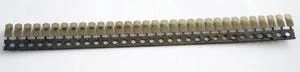
To achieve sufficient throughput with the one-hour testing cycle, Sensata temporarily groups 32 strips into an array of 1024 bimetal disks (Fig. 2). The array is then loaded into a proprietary oven developed by TCPM to hold and heat the array.

The oven is a metal enclosure with glass plates for a roof, as well as two sides and open vets on the other two sides to allow forced heated air to pass through the enclosure. High-frequency, high-output fluorescent lights shine through the glass walls of the enclosure to illuminate the array from all sides and reduce shadows. Initially, TCPM used red LEDs with a red filter placed over the camera to improve contrast, but the press plates that form the roof of the oven did not let sufficient light through to make a good image. A metal nest is attached to the floor of the oven to hold the bimetal disk array in place.

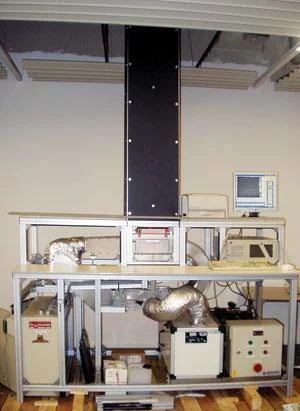
Above the oven is the camera enclosure. A 1600 × 1200-pixel Prosilica CCD camera with Gigabit Ethernet output is mounted at the top of the enclosure (Fig. 3). TCPM used standard optics and a longer stand-off distance to reduce optical distortion of the bimetal disks while keeping costs down.

"You have to have the camera relatively high in the chamber to get an accurate field of view," notes TCPM's Slatius. "If it's too close, you get distorted images of the disks on the edges. We just use a standard 35-mm C-mount lens. We went with a Prosilica GigE camera because we wanted to do all the processing at the PC, so we needed high bandwidth, and not all PCs have FireWire ports."
Getting hotter

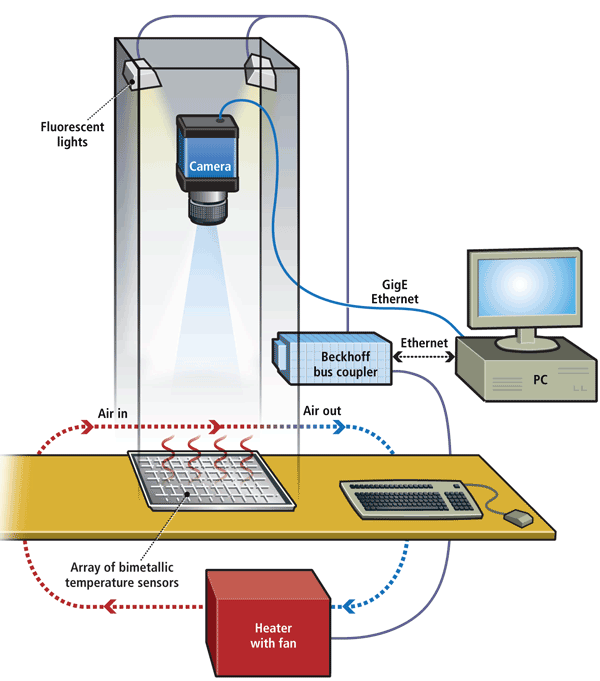
After the array is loaded into the oven, the operator initiates the system via an operator interface and supervisory program written in Microsoft Visual Basic (VB) that runs on a generic desktop PC with Windows XP. The VB shell program sends a signal via Ethernet I/O to a Beckhoff EtherCAT BK1120 expandable bus coupler. The BK1120 acts as a switch to control all nonimaging peripherals, including the heater located below the oven, a fan to move the heated air through the test oven, the two HF/HO fluorescent lights, and six Pt100 platinum resistance thermometers (Fig.4).

"The thermometers provide temperature readings from different parts of the oven for greater accuracy and also feed a separate safety circuit connected to the EtherCAT bus that ensures the temperature does not exceed the maximum of 200°C," explains Slatius.

"The temperature values are also sent through the Beckhoff bus coupler to the PC for recording the temperature values when a bimetal disk snaps." As the temperature is gradually increased inside the oven, the Prosilica camera captures images at the rate of 5 frames/s. "The camera operates at rates up to 15 frames/s but only uses 5 frames/s and could probably get by with 2 frames/s," explains Slatius.

Each image is fed across Cat 5 cable to the PC. HALCON algorithms take over, first filtering the image, then locating bimetal disks. "First, we filter the image to get rid of noise and reflections from the safety windows. Sometimes, we also get reflections from the base-metal strip; knowing the distance between disks helps us to filter out these reflections and focus on the disk," continues Slatius.

"After filtering, we use a blob algorithm to determine the location of each bimetal disk and track the movement for each disk from frame to frame. When the percentage change exceeds a certain value, we say the snap has occurred. The system then records the temperature value from the closest PRT sensor, plus the numbered location of the disk in the array under test. The system records these values in a text file that can be imported into an Excel spreadsheet for final review by production staff.

"We also look at the average snap temperature per batch and use that as a way to track changes in the bimetal disk stamping and welding process. By tracking the sigma value, the customer can track tool wear and quality level of the production line," says Slatius.

According to Slatius, future enhancements to the system will include the use of a thermal model of the oven in determining the switching temperature to get a more accurate result, which should lead to a shorter cycle time, faster feedback, and improved production yield.

Author: Winn Hardin

Article kindly provided by Vision Systems Design. TCPM is an MVTec Certified Integration Partner All product names, trademarks and images of the products/trademarks are copyright by their holders. All rights reserved.

Published on: August 24, 2013

Further News

MVTec MERLIC 26.03 is available now
With MERLIC 26.03, developing and operating machine vision applications becomes more consistent and scalable. The release introduces the unified MVTec versioning format (YY.MM) and a simplified, package-based licensing model with flexible add-ons.
Read more
MERLIC
New version of the Deep Learning Tool significantly boosts Deep OCR performance
With Deep OCR Alignment and other improvements, Deep Learning Tool 26.03 enhances speed and efficiency for OCR applications. New models, optimized training, and CUDA 12.8 support bring higher performance with lower memory usage.
Read more
Deep Learning Tool
New MVTec Academy course: Mosaicking – stitching images with HALCON
This basic training introduces you to the mosaicking technologies in HALCON. The course shows you how to combine several images into one large mosaic image. Thus, this technology enables you to create a large image of an object or scene that would ot…
Read more
Academy
HALCON
New MVTec Academy course: Parallel programming with HALCON
This advanced training introduces you to the concept of parallel programming with HALCON. The application of parallel programming allows you to optimize the performance of your HALCON program and take full advantage of multicore or multiprocessor ha…
Read more
Academy
HALCON
Opticum d.o.o. becomes a MVTec Certified Integration Partner
The company based in Vojnik, Slovenia, specializes in industrial printing, machine vision, weighing, labeling, and traceability, serving primarily the pharmaceutical industry.
Read more
Certified Integration Partner
VST Taiwan becomes a new member of MVTec’s partner network
The automated optical inspection (AOI) specialist VST Taiwan has joined the MVTec Certified Integration Partner Program and offers services in optical system design, mechanical structure planning, and key vision components.
Read more
Certified Integration Partner
New version 1.6.5 of the MVTec Software Manager
The latest version of the MVTec Software Manager is now available and brings several enhancements to improve usability and performance.
Read more
MVTec
New MVTec Academy course "Develop a custom tool for MERLIC"
This advanced training introduces you to the development of custom tools for MERLIC to extend the existing MERLIC tool library.
Read more
Academy
MERLIC
New version 25.12 of the MVTec License Server released
With MVTec License Server Cloud-Ready 25.12, HALCON licenses can be borrowed, enabling operation during network failures and offline.
Read more
MVTec
MVTec Deep Learning Tool 25.12 is out now
On December 4, 2025, we released the new version 25.12 of the MVTec Deep Learning Tool and thus consistently further developed our portfolio for AI-based machine vision.
Read more
Deep Learning Tool
MVTec welcomes new partner Micro-Epsilon
We are pleased to welcome Micro-Epsilon, a globally operating specialist in high-precision sensor and measurement technology, to our Technology Partner Program.
Read more
Technology Partner
New MVTec Academy course "Image acquisition: The interface for modern camera technology"
This training course will introduce you to the new image acquisition operators. Through practical exercises, you will learn the necessary technical terms and concepts, and deepen your knowledge.
Read more
Academy
HALCON
HALCON 25.11 is available now
The new version of MVTec HALCON is now available for download. This version again brings some improvements as well as new features, such as Continual Learning – Classification, a new technology that makes training and maintaining classification model…
Read more
HALCON
DISYS joins MVTec Partner Network with expertise in advanced vision systems
The company from Schio, Italy, develops fully customized AI-powered solutions for diverse industries, from manufacturing to pharma, automotive, packaging, and food & beverage.
Read more
Certified Integration Partner
New MVTec Academy course "Code integration with language interfaces"
This advanced training course covers the integration and use of the HALCON library in software projects written in C, C++, C#, Visual Basic .NET, and Python.
Read more
Academy
HALCON
New MVTec Academy course "Image acquisition with GigE Vision"
This advanced course provides in-depth information on using GigE Vision cameras with HALCON.
Read more
Academy
HALCON
VRAiA CORP S.L. joins the MVTec Partner Network
The company from Aspe (Alicante, Spain) applies robotics and machine vision in tire production, focusing on final inspection and quality assurance.
Read more
Certified Integration Partner
robomotion strengthens the MVTec Partner Network
The German company specializes in customized automation solutions for demanding applications in food, medical technology, packaging, and plastics industries.
Read more
Certified Integration Partner
Halley Informatica strengthens the MVTec Partner Network
The division Halley Machine Vision specializes in 3D vision and robot guidance solutions for industrial automation and quality control.
Read more
Certified Integration Partner
Trifid Automation s.r.o. joins the MVTec Partner Network
The company from Slovakia provides advanced machine vision solutions for quality control and inspection across automotive, rubber, engineering, and wood industries.
Read more
Certified Integration Partner
MVTec MERLIC 5.8 is available now
MVTec MERLIC 5.8 makes developing and operating vision applications easier than ever, with improved error handling, centralized recipe management, and faster, more flexible deployment.
Read more
MERLIC
GosTech Kft. joins the MVTec Partner Network
With expertise in machine vision, optical and electrical measurement, and automation, GosTech Kft. delivers high-value solutions across multiple industries.
Read more
Certified Integration Partner
Digiinov SA adds industrial software and machine vision know-how to the MVTec Partner Network
The Swiss company supports machine builders with industrial software development and customized machine vision solutions based on HALCON.
Read more
Certified Integration Partner
New MVTec Academy course "Hand-eye calibration"
In this advanced course, you will learn how to perform hand-eye calibration using HALCON.
Read more
Academy
HALCON
SIGA Vision Ltd joins the MVTec Partner Network
Backed by the Mpac group, SIGA Vision delivers seamless vision systems and turnkey solutions for food and beverage, consumer goods, and healthcare industries.
Read more
Certified Integration Partner
VISOR – AOI and automation specialist joins the MVTec Partner Network
Founded in 2007, VISOR develops customized AOI and automation solutions and is today a leading provider of industrial vision systems in Southeastern Europe.
Read more
Certified Integration Partner
Smart Services becomes a new member of MVTec’s partner network
Smart Services has joined the MVTec Certified Integration Partner Program, offering machine vision solutions for identification, measurement, object and position detection, and quality inspection.
Read more
Certified Integration Partner
Herzog VSA becomes a certified integration partner of MVTec
The Herzog VSA specialises in challenging machine vision projects, with a strong focus on 3D data processing, line scan camera applications, and hybrid 2D/3D systems.
Read more
Certified Integration Partner
Agmanic Vision becomes a new member of MVTec’s partner network
Computer vision specialist Agmanic Vision has joined the MVTec Certified Integration Partner Program and delivers AI-driven solutions for quality control, robotics, and embedded applications.
Read more
Certified Integration Partner
New version 25.08 of the MVTec License Server released
The update makes it easier to run the License Server as a Windows system service and provides improved access to documentation.
Read more
MVTec
MVTec welcomes Optotune as new partner
MVTec is pleased to welcome Optotune Switzerland AG as the latest company to join its Technology Partner Program. Through this collaboration, MVTec’s powerful machine vision software is complemented by Optotune’s cutting-edge focus-tunable lenses and…
Read more
Technology Partner
Certified Integration Partner Autolab becomes a new member of MVTec’s partner network
Autolab GmbH is the latest addition to MVTec's Certified Integration Partner Program, delivering advanced solutions for visual quality inspection and inline measurement using deep learning and classical machine vision.
Read more
Certified Integration Partner
New MVTec Academy course "Inspect the print quality of bar and 2D data codes"
In this advanced training course, you will learn how to perform print quality inspection for bar and data codes using HALCON and MERLIC.
Read more
Academy
HALCON
MERLIC
Preview version of HDevelopEVO: new update now available
Faster, more intuitive, and interactive programming: All HALCON users can now download the new IDE preview version.
Read more
HALCON
New MVTec Academy course "Defect detection"
This basic training introduces you to defect detection with MVTec HALCON. In this training, you learn different approaches and what to consider when developing a defect detection application. Then, you solve some challenging applications with differe…
Read more
Academy
HALCON
Visione Artificiale srl becomes a new member of MVTec’s partner network
Visione Artificiale srl has joined the MVTec Certified Integration Partner Program, offering turnkey vision solutions for quality control, defect detection, robot guidance, and process optimization.
Read more
Certified Integration Partner
Bertram Elektrotechnik becomes a new member of MVTec's partner network
Automation specialist Bertram Elektrotechnik adds its expertise in robotics, test engineering, and image processing to the MVTec Certified Integration Partner Program.
Read more
Certified Integration Partner
New MVTec Academy course "Working with regions"
This basic training introduces you to the concept of regions in HALCON. You learn how to create regions manually as well as by different segmentation approaches, process regions, and access different features of regions.
Read more
Academy
HALCON
New MVTec Academy course "Speed up deep learning with AI²"
his advanced training shows you how to optimize your deep learning applications in terms of inference runtime and memory requirements using MVTec’s AI Accelerator Interface (AI²).
Read more
Academy
HALCON
MERLIC
MVTec HALCON software box with surfer – new version
HALCON 25.05 is available now
The new version of MVTec HALCON is now available for download. With this release, MVTec focuses on improving HALCON’s ease-of-use and rule-based machine vision.
Read more
HALCON
Advancing Anomaly Detection: VAND 2025 Challenge at CVPR 2025
We’re thrilled to announce the Visual Anomaly and Novelty Detection (VAND) 2025 challenge, a premier event at CVPR 2025. Sponsored by Voxel51, Intel, and MVTec, this challenge aims to push the boundaries of anomaly detection in industrial application…
Read more
MVTec
MVTec Deep Learning Tool 25.04 is out now
On April 30, 2025, we released the new version 25.04 of the MVTec Deep Learning Tool and thus consistently further developed our portfolio for AI-based machine vision.
Read more
Deep Learning Tool
MVTec on Campus celebrates 5 years with Vision Hero campaign
MVTec Software GmbH is proud to announce the 5-year anniversary of its successful educational initiative MVTec on Campus. To mark this special milestone, MVTec is launching a unique and engaging campaign: Vision Heroes – Saving Yogurt Village.
Read more
MVTec
MVTec MERLIC 5.7 is available now
With the new version MERLIC 5.7, MVTec continues their established path with MERLIC – easy process integration combined with powerful machine vision methods. The new version improves the usability of MERLIC Runtime Environment (RTE) and optimizes the…
Read more
MERLIC
New MVTec Academy course "Read bar codes"
This basic training teaches you how to read bar codes with HALCON and MERLIC.
Read more
Academy
HALCON
MERLIC
Mission Accomplished: MVTec's Christmas Quiz
As we wrap up our Christmas quiz, we’re excited to share the fantastic results.
Read more
MVTec
MVTec Software