
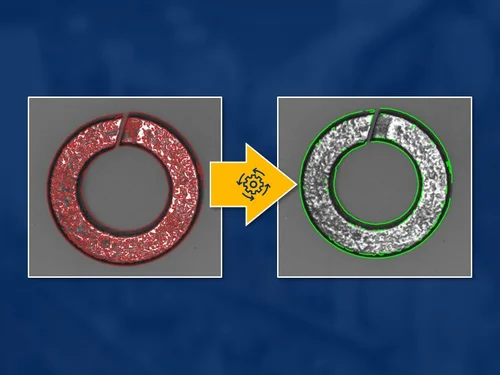
With HALCON 26.05, automatic contour optimization for shape-based matching (SBM) enables users to automatically remove unstable or misleading contours from SBM models. Reflections, shadows, or random texture often introduce unreliable contours that reduce matching robustness and require labor-intensive manual cleanup. With the new feature, users simply provide sample images of real object instances. Based on these samples, the system analyzes which contours appear consistently across variations and retains only the stable contours while removing unreliable ones.
By focusing the model on robust contours only, matching becomes faster, more stable, and more accurate. The feature replaces time-consuming manual contour editing with a data-driven optimization step during model training. It is particularly valuable for reflective or textured objects, such as mechanical or electronic components, and for automation scenarios like feeder-based pick-and-place systems where stable matching is critical. The automated optimization also reduces the effort for retraining models when new objects are introduced, making inline retooling more practical in production environments.

HALCON 26.05 expands its code reader with Data Matrix rectification, enabling reliable reading of Data Matrix codes even when they appear on curved or deformed surfaces. In many industrial applications, codes are printed on non-flat materials, which can distort the symbol geometry and reduce reading reliability. With the new rectification capability, HALCON compensates for these distortions before decoding, significantly improving robustness in such scenarios.
The rectification step can be enabled optionally within the code reader and integrates seamlessly into existing workflows. Although processing time is slightly higher than with standard Data Matrix reading, the improved decoding reliability enables stable operation in demanding environments. Typical applications include codes printed on cylindrical components, curved packaging, or flexible materials used in manufacturing and logistics.
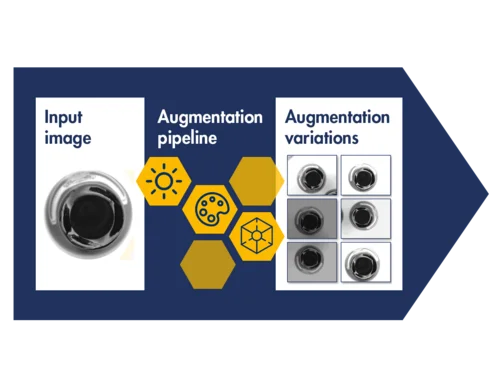
HALCON 26.05 introduces enhanced data augmentation for deep-learning workflows. The new approach replaces the previous procedure-based augmentation and preprocessing steps with configurable operators that integrate directly into HALCON deep-learning pipelines.
Users can define augmentation pipelines programmatically, apply transformation techniques such as geometric transforms, color variations, and blurring, and preview the resulting image variations. This lets developers test and refine augmentation strategies quickly within their existing workflow. Training samples generated this way help model robustness and generalization, which can reduce the reliance on large training datasets.
This feature is initially available for object detection and instance segmentation, supporting more reliable training and improving model generalization under challenging conditions such as varying illumination, perspective changes, occlusions, or noisy image data.

A new generation of deep-learning-based object detection is available with HALCON 26.05, delivering up to 5x faster inference while maintaining high detection accuracy. The new architecture enables efficient detection of objects and is optimized for demanding machine vision scenarios where both speed and precision are critical.
Users can train and run detection models directly within HALCON and start from MVTec-provided pretrained models that can be adapted to specific applications. The anchor-free detection approach improves bounding-box localization and performs reliably even for small objects and varying object sizes. Integrated data augmentation techniques further increase robustness against changes in illumination, rotation, distortion, and partial occlusion. The feature integrates directly into HALCON workflows and supports inspection, localization, and sorting tasks across industrial automation applications.