Success Story
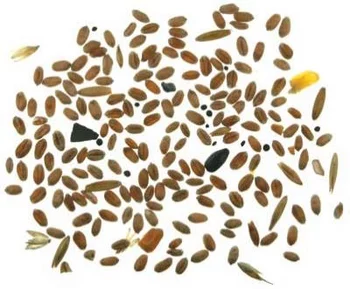
After wheat is harvested, it is placed in large grain storage units before it is shipped to flour mills. To determine the price of this wheat, a sample must first be analyzed to measure its baking properties, whether any toxic substances from fungi are present, and how the wheat sample may differ from the normal basic variety.
Today, there are different standard procedures to measure parameters such as the wheat's gluten level and moisture content that directly affect its baking properties. Available methods also exist to determine whether any toxic substances produced by fungi are present. However, the standard way of analyzing the compound of a wheat sample is performed by laboratory assistants or leading millers who manually sort the wheat into different classes.
To accomplish this, the sample is first sieved, and undersized and oversized particles separated out and the rest examined. Since analyzing a sample of 200 g (nearly 4000-5000 objects) can take from 30-45 min, this is both a time-consuming and error-prone procedure.
To overcome the challenges, engineers at the Faculty of Machine Engineering of the Technical University of Ilmenau have developed an automated machine-vision system that performs the analysis task automatically while significantly extending the wheat sample size and obtaining results faster and with a higher statistical confidence.
To accomplish this, the wheat is analyzed by first sieving the wheat then determining the amount of sound, plump, whole kernels, and other material such as foreign seeds, weed seeds, chaff, and stones (known as Besatz) that may be present. Finally, by setting acceptance/rejection criteria, the price can be automatically determined.
By counting the number of objects belonging to different classes such as flawless, broken, or shriveled wheat, wheat damaged by pests, foreign seeds, and chaff, and then combining these into super-ordinated groups such as flawless wheat, unsound grain, and Besatz, the recognition problem is less complex and the error rate can be reduced.
Image analysis is performed by algorithms that use different color, texture, and shape features as input parameters. Sample objects imaged by an area-array CCD camera under incident light on a bright background show the large variability of the objects in size, shape, and color. Since the variety is so large, a sample dataset is required with a large number of representative objects per class and a powerful object classifier with high generalization ability must be used.
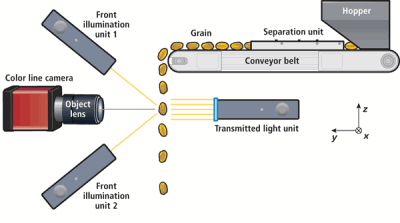
To rapidly analyze wheat samples, they are first placed in a hopper where they fall onto a conveyor belt and move through a separation unit that is designed to separate the objects from each other and present them to the camera individually. The objects then fall from the conveyor where images are captured using a CV-L107CL three-CCD color linescan camera from JAI with Camera Link interface and an achromatic macro lens from Carl Zeiss. To illuminate the wheat as it falls in front of the field of view of the camera, three separate LED line lights are used (see Fig. 2).
Additionally, a second three-CCD color linescan camera can be used with an illumination system in the opposite position from the first camera to observe the front and backside of objects from the wheat sample. After object capture and classification, specific classes can be subdivided with a pneumatic sorter for weighing and stock-keeping. In this way, material handling and separation of every object is carried out automatically.
After images are captured they are transferred to a host PC where the samples are classified. First, image segmentation is used to separate objects from their background. Feature extraction is then used to determine the particular features of each object.
Combining color, shape, and texture features then results in one feature vector for each object that contains 198 feature values. Both image segmentation and feature extraction are accomplished using image operators, mostly from the HALCON 8.0 machine-vision library from MVTec.
After features are extracted from the images, image classification must be used to determine the features of each object in the wheat sample. To correctly train the classifier used to analyze the wheat samples, a large number of manually examined preclassified objects samples were required. For this, German grain mills and the Max Rubner-Institut collaborated on testing samples of old and new crops and generated a database of preclassified objects.
Using a support vector machine (SVM), a total recognition rate of 94% and individual recognition rates ranging from 69% to 99% were achieved for 23 object classes from different cereal varieties, such as flawless wheat and rye; different grain impurities of wheat, such as broken wheat and sprouted wheat; and miscellaneous impurities, like weed seeds, stones, and other contaminants. Recognition rates ranging from 81% to 99% were achieved by aggregation of the 23 subclasses in the relevant super-ordinated classes of flawless wheat, ergot, unsound grains, and other classes of Besatz such as broken wheat, shriveled wheat, and foreign seed.
Since the sample throughput of the system is 50 g per minute, the automatic analytical process provided extensive results after a short period of time; the composition of an analyzed grain sample can be displayed graphically. Additionally, the weight of the total sample, the weight of the flawless wheat, and the numerical and graphical statistics of the analyzed sample can be determined and stored in a database.
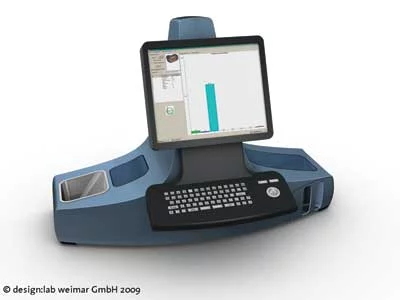
After the initial project was successfully completed, a conceptual prototype design of a standalone system was developed by design:lab Weimar.
Authors: Peter Brückner, Katharina Anding, Martin Dambon, and Daniel Garten
Article kindly provided by Vision Systems Design. All product names, trademarks and images of the products/trademarks are copyright by their holders. All rights reserved.