MVTEC HALCON

Structured-light-based vision system inspects percussion caps – Tekniker

The Tekniker Foundation uses HALCON and 2D/3D cameras for high-speed inspection of percussion caps. Defects such as dents, misalignment, or missing caps are reliably detected – up to 216,000 units per hour.
HALCON
Machinery
3D Calibration
3D Vision
Blob Analysis
Matching

The Centro Tecnológico Tekniker has developed a very fast system to inspect percussion caps. Percussion caps are a critical component used in manufacturing ammunition. Produced in mass quantities, these explosive caps must be fabricated with strict tolerance requirements and inspected with 100% accuracy. A leading producer of hunting cartridges has approached Dr. Alberto Tellaeche of the Tekniker Foundation Technological Center to develop an automated system that can inspect these parts at rates as fast as 216,000 units/hour. The system inspects plates containing 600 percussion caps per plate to achieve these rates as the caps are presented to the system along a conveyor.

"Many different errors can appear during the production of these percussion caps," says Tellaeche. "For example, the central part of the cap may be dented, badly mounted, inverted, or mounted above or below the correct tolerance in the plate. Other errors may include missing caps or dirty caps." Previously, this inspection was performed manually with statistical samples being extracted at random for analysis by a human inspector.

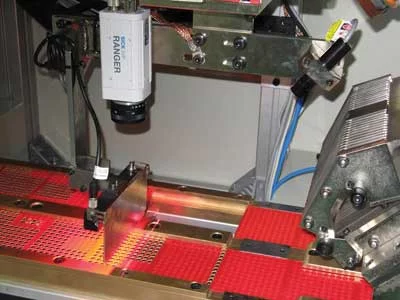
To perform the in-plate inspection of the percussion caps, Tellaeche and his colleagues realized that it would be necessary to capture both 2D and 3D images of the parts as they moved along a production line. By deploying a structured 3B class line-projecting red laser beam for the 3D image acquisition and a diffuse red barlight for the 2D image acquisition, images could be captured using a Ranger E55 camera from Sick.

The system designers divided the sensor in the camera in different zones, enabling the camera to simultaneously capture 512 × 3300 × 8-bit 2D images and 512 × 3300 × 16- bit 3D images. The 35k line profiles generated per second were then transmitted over the camera's GigE interface to an Intel Core 2 Quad Q9550 CPU running at 2.83 GHz.
"Because the system must be capable of inspecting a plate containing 600 percussion caps in less than 8 s," says Tellaeche, "the HALCON 9.0 Machine Vision library from MVTec was chosen because it is fast and image-processing functions can be parallelized across the four cores of the processor."

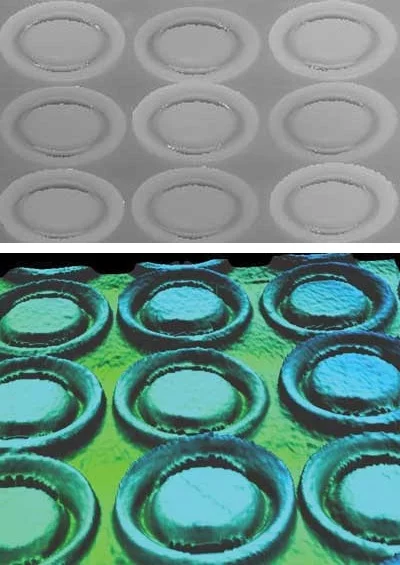
Different image-processing algorithms are used on the individual 2D and 3D images generated by the Sick camera. In each of the images, five regions of interest (ROIs) are generated corresponding to the five groups of 120 percussion caps present in each plate. Within each ROI, a model finder operation is performed using a synthetic model of a percussion cap based on geometrical shape. Using this model finder, all the percussion caps in the images can be perfectly located and further image-processing functions performed.

For each of the percussion caps present in the 2D image, a threshold and a blob analysis of the central capsule are performed. Post-thresholding, the circularity of the central capsule is determined. After circularity is calculated, the area of the central capsule is determined using blob analysis. To complete 3D image processing, six line profiles are programmed for the analysis of each percussion cap—three horizontally and three vertically. Due to the nature of the imaging system, each percussion cap has an elliptical shape, so the parameters of the line profiles differ depending on the type of line profile—whether they are horizontal or vertical. Because of irregularities in the plate containing the percussion caps and the errors in the positioning of the pieces, the profile obtained may not be perfectly horizontal in the central part.

After line profiles are generated, the width of the central capsule is determined from the position of the maximum and minimum points of the line profile at the beginning and end of the percussion cap. Errors related to the fabrication tolerance of the caps are determined by comparing the height values of the central capsule and the values of the borders of the external capsule. Other errors are determined by calculating the divergence of the height values of the percussion cap's central capsule.
Using statistical analysis, a regression line of the values corresponding to the central capsule of the percussion cap can then be calculated. From this regression line, the height values that the central capsule should exhibit can be estimated and the tolerance determined. By using the slope and bias of the regression line, the system can determine whether the central capsule of the percussion cap or the cap itself is missing.
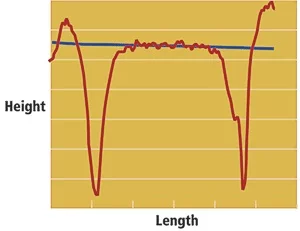
To determine whether the central capsule is mounted above or below tolerance, the differences between the two maximum values of the percussion cap and the theoretical value of the regression line are used. If this mean value is small and within the tolerance permitted, the central capsule is passed as a good part; if larger, then the capsule is mounted below tolerance and is rejected.

"Replacing the need for statistical manual analysis of percussion caps has resulted in an automated system capable of inspecting 100% of every cap," says Tellaeche. "Statistically, this means that the system will only make three possible errors out of every 100,000 percussion caps that are inspected."

Article kindly provided by Vision Systems Design.All product names, trademarks and images of the products/trademarks are copyright by their holders. All rights reserved.

Published on: August 25, 2013

Weitere Stories

MVTec HALCON product icon
Projektion der von einer Kamera erkannten Pupillenkoordinaten auf das Bild einer zweiten Kamera zur exakten Bestimmung der Glasposition.
Image Processing Automates Eyeglass Fitting for Rodenstock
Imagine that you wear varifocal glasses and need new ones. You go to an optometrist and, without time-consuming adaptations, measuring or trying on frame after frame, you look at yourself in a mirror and - voila! - your chosen frame is on your nose.
Show full Story
HALCON
Glass, Metal, Paper, Foil & Printing
Classification
Matching
Measuring
MVTec HALCON product icon
Visualisierung eines People-Counting-Systems am Gebäudeeingang mit 3D-Erfassungsbereich, Ein- und Ausgangsmarkierungen sowie Anzeige zur aktuellen Personenzahl zur sicheren Zutrittskontrolle.
Simple and reliable control of the number of persons within a building with MVTec HALCON
Strelen Control Systems GmbH is a Certified Integration Partner of MVTec with seat in Büttelborn, close to Darmstadt, Germany. The solutions developed by Strelen are suitable for the inspection and analysis as well as for the automation and regulatio…
Show full Story
HALCON
Security & Surveillance
Blob Analysis
Morphology
MVTec HALCON product icon
Battery laser welding system used in automated battery production with integrated machine vision inspection.
Full quality control with HALCON´s deep learning functions
One of the key challenges in automated battery production is achieving stable welds without damaging the housing. To meet strict automotive quality standards while reducing costs, Manz AG is developing inline inspection systems that enable full proce…
Show full Story
HALCON
Battery Production
Electric Components
Machinery
Anomaly Detection
Deep Learning
Inspection
MVTec HALCON product icon
Camera test chart with line patterns and a Siemens star used for measuring resolution, contrast, and optical performance.
DCTau: A photographer's tool for testing digital cameras based on HALCON
DCTau by Anders Uschold, Munich, provides a standardized test for evaluating digital cameras with minimal operator input. Designed for both beginners and professionals, it measures resolution, contrast, noise, sharpening, distortion, and brightness l…
Show full Story
HALCON
Education, Research & Science
Measuring
MVTec HALCON product icon
HERON - Middleware for Image Retrieval Using Graphical Features Extracted by HALCON
The interdisciplinary HERON project aims to find images in digital libraries or large archives without detailed domain knowledge. Initially applied to heraldry, the methods can also be used in medical imaging or trademark collections. HERON uses inno…
Show full Story
HALCON
Education, Research & Science
Classification
Filtering
Matching
MVTec HALCON product icon
Support of Intelligent Rooms by Image Processing
In recent years, rooms with intelligence are studied. This kind of rooms is becoming important not only for medical or welfare use, but also at offices or ordinary houses. Obviously, the man-machine interface to communicate human intention is a subst…
Show full Story
HALCON
Education, Research & Science
Classification
Filtering
MVTec HALCON product icon
Machine Vision Solves "Needle-in-a-haystack" Problem for Small Parts Manufacturer, Developed by Data Systems
Data Systems solves the “needle-in-a-haystack” challenge for a small parts manufacturer using HALCON-based machine vision. The system automatically inspects, sorts, and classifies over 300,000 part variations, checking size, type, coating, and laser…
Show full Story
HALCON
Machinery
Packaging & Logistics
Matching
OCR
MVTec HALCON product icon
Package label with barcode and printed text used for automated barcode reading and OCR.
Machine Vision Speeds Package Bar Code Reading at Quelle GmbH
At Quelle GmbH's logistics center in Leipzig, 80,000 packages are processed daily. To enhance efficiency, the company employs a combined machine vision system with barcode reading and OCR. Utilizing Baumer i-Cam 108 cameras and MVTec's HALCON softwar…
Show full Story
HALCON
Machinery
Packaging & Logistics
Bar Code & 2D Code Reading
OCR
MVTec HALCON product icon
Manual handling of a helicopter on a ship deck under rough sea conditions.
Automatic Helicopter Handling System from FHS Förder- und Hebesysteme GmbH
FHS Förder- und Hebesysteme GmbH is a leading supplier of defense technology and naval technology. The company has a long experience and competences in development and production of systems and machines with electrical hydraulical drives and control…
Show full Story
HALCON
Robotics
Calibration
Measuring
MVTec HALCON product icon
The Presetter and Measuring Machine SATURN from Zoller – Measurement of Tools with HALCON
The ZOLLER SATURN measuring machine employs HALCON for precise tool measurement in the micrometer range. Subpixel algorithms automatically extract geometric properties from the tool shape. Camera calibration ensures consistent precision across the en…
Show full Story
HALCON
Machinery
Calibration
Measuring
MVTec Software