MVTEC HALCON

Vision system sorts tomato seedlings - University of Wageningen

The University of Wageningen’s system automates the sorting of tomato seedlings at a rate of up to 18,000 plants per hour. Using ten cameras and 3D modelling, the biomass of each seedling is calculated and classified into quality categories automatically.
HALCON
Agriculture
Food & Beverage
3D Vision
Calibration

More than 150 million tons of tomatoes are produced every year around the world. With seedlings costing €0.25, plant growers such as Westland Plantenkwekerij (WPK; Rotterdam, the Netherlands) must ensure that the seeds they receive from their suppliers will germinate as expected.

Seed suppliers provide germination percentage estimates by sampling batches of tomato seeds; however, plant growers must ensure that the seeds will flourish. If not, growers may overpay for the batches of seeds they receive. With companies like WPK growing several million plants per year, such losses can rapidly appreciate.

Within their contract research organization based at the Wageningen University & Research Centre, the Netherlands, Rick van de Zedde and his colleagues have been developing vision applications in the agrifood industry for more than 20 years. In this project, they studied how numerous growers evaluate their tomato seedlings. Although multiple characteristics such as shape and color were evaluated by the growers, it became clear that the seedling sorting process could be robustly automated by measuring the mass of each seedling.

FBR designed the machine vision system (see Fig. 1), and Flier Systems, Barendrecht, the Netherlands, currently builds the machine.

Now installed at WPK's facility in Made, the Netherlands, the machine is capable of sorting tomato seedlings at a rate of 18,000/hr. According to Erik van der Arend, owner and director of WPK, the current version of the system sorts seedlings on the basis of the plant's biomass; it will eventually be upgraded to sort plants based on multiple characteristics such as the plant's shape, size of the leaves, and defects in shape or color.

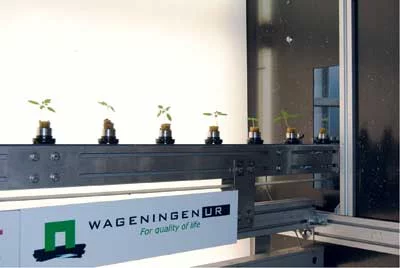
In the WPK facility, seeds are automatically planted into trays each containing an array of 12 × 20 pots. After a 12-day germination period, these trays are then manually transferred onto a conveyor that feeds them into a pick-and-place machine. This is used to separate each pot 10 cm apart onto the conveyor of the machine-vision system (see Fig. 2).

As each pot enters the vision station, an optical switch triggers the presence of the plant. Interfaced to a programmable logic controller (PLC), the switch is also interfaced to an NI PCI-6518 digital I/O card from National Instruments (Austin, TX, USA) that is in turn used to trigger 10 acA1300-30gm 1296 × 966-pixel monochrome Gigabit Ethernet cameras from Basler (Ahrensburg, Germany), each fitted with a 25-mm Fujinon lens from Fujifilm (Wayne, NJ, USA). The images are transferred over the Gigabit Ethernet interface to a host PC that incorporates three Intel PRO/1000 PT quad-port server adapter cards.

"Because of the relatively complex and nonuniform nature of the seedling plants," says van de Zedde, "ten cameras were required to properly recreate a three-dimensional model of the plants. And still our software is able to generate a 3-D model and calculate the biomass within 25 msec per seedling."

To calibrate these cameras, a flat checkerboard pattern is used in conjunction with a modified stereo-vision calibration algorithm available in the HALCON software package from MVTec Software, Munich, Germany.

Because plants are illuminated by a high-frequency fluorescent backlight, the 10 captured images provide multiple views of the seedlings under inspection from different viewpoints. By subtracting the background from each of these images, a silhouette of the plant at different viewpoints can be created.

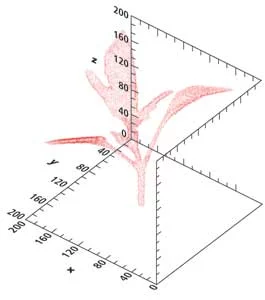
Then by using a technique known as Space Carving, a 3-D rendering of the plant can be created (see Fig. 3). Using this method, the biomass of each plant can be computed and the data used to classify each plant.

In the system deployed at WPK, plants are classified into four categories based on the volume, i.e., the biomass of the seedling. Based on the average size of a batch, the end user can adjust the boundaries per category. This results in first-, second-, and third-class seedlings and rejects (too small/ nongerminated).

The automated classification results from the PC are transferred to a PLC, which triggers a number of actuators to move each plant onto a particular conveyor depending on the classification result.

At present, FBR's van de Zedde is installing the next machine at a breeder and is upgrading the vision system to sort seedlings based on other plant characteristics, including color. "But the productivity gain in the quality of sorting is already huge," says WPK's van der Arend, "since our investment in this machine will be recovered within four years."

Author: Andy Wilson

Article kindly provided by Vision Systems Design.

All product names, trademarks and images of the products/trademarks are copyright by their holders. All rights reserved.
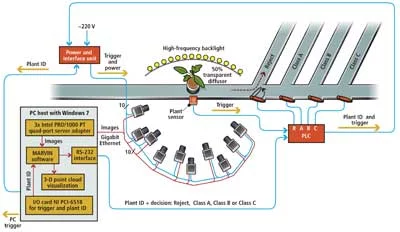
System diagram showing a multi-camera setup and triggering for 3D volume-based classification of tomato seedlings.
Fig. 2: As each pot enters the vision station, an optical switch triggers the presence of the plant and 10 individual images of the plant are captured from numerous angles. The plants are classified according to volume after a high-speed calculation.
Three-dimensional plant volume reconstruction using space carving for automated tomato seedling classification.
Fig. 3: Using a technique known as Space Carving, a three-dimensional rendering of the plant can be created, the biomass computed, and the data used to control actuators to automatically sort each plant.

Published on: September 06, 2013

Weitere Stories

MVTec HALCON product icon
Projektion der von einer Kamera erkannten Pupillenkoordinaten auf das Bild einer zweiten Kamera zur exakten Bestimmung der Glasposition.
Image Processing Automates Eyeglass Fitting for Rodenstock
Imagine that you wear varifocal glasses and need new ones. You go to an optometrist and, without time-consuming adaptations, measuring or trying on frame after frame, you look at yourself in a mirror and - voila! - your chosen frame is on your nose.
Show full Story
HALCON
Glass, Metal, Paper, Foil & Printing
Classification
Matching
Measuring
MVTec HALCON product icon
Visualisierung eines People-Counting-Systems am Gebäudeeingang mit 3D-Erfassungsbereich, Ein- und Ausgangsmarkierungen sowie Anzeige zur aktuellen Personenzahl zur sicheren Zutrittskontrolle.
Simple and reliable control of the number of persons within a building with MVTec HALCON
Strelen Control Systems GmbH is a Certified Integration Partner of MVTec with seat in Büttelborn, close to Darmstadt, Germany. The solutions developed by Strelen are suitable for the inspection and analysis as well as for the automation and regulatio…
Show full Story
HALCON
Security & Surveillance
Blob Analysis
Morphology
MVTec HALCON product icon
Battery laser welding system used in automated battery production with integrated machine vision inspection.
Full quality control with HALCON´s deep learning functions
One of the key challenges in automated battery production is achieving stable welds without damaging the housing. To meet strict automotive quality standards while reducing costs, Manz AG is developing inline inspection systems that enable full proce…
Show full Story
HALCON
Battery Production
Electric Components
Machinery
Anomaly Detection
Deep Learning
Inspection
MVTec HALCON product icon
Camera test chart with line patterns and a Siemens star used for measuring resolution, contrast, and optical performance.
DCTau: A photographer's tool for testing digital cameras based on HALCON
DCTau by Anders Uschold, Munich, provides a standardized test for evaluating digital cameras with minimal operator input. Designed for both beginners and professionals, it measures resolution, contrast, noise, sharpening, distortion, and brightness l…
Show full Story
HALCON
Education, Research & Science
Measuring
MVTec HALCON product icon
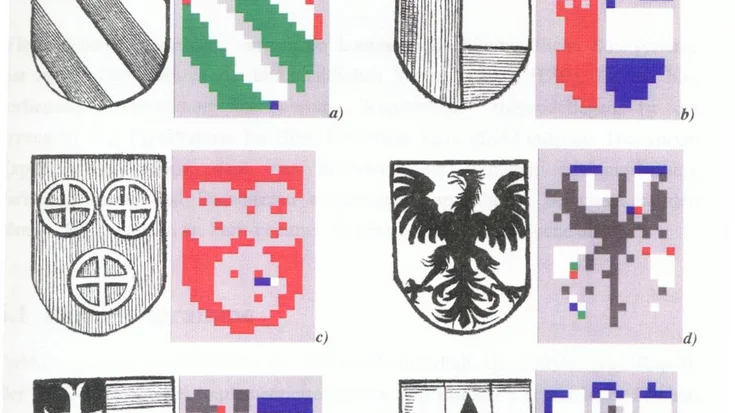
HERON - Middleware for Image Retrieval Using Graphical Features Extracted by HALCON
The interdisciplinary HERON project aims to find images in digital libraries or large archives without detailed domain knowledge. Initially applied to heraldry, the methods can also be used in medical imaging or trademark collections. HERON uses inno…
Show full Story
HALCON
Education, Research & Science
Classification
Filtering
Matching
MVTec HALCON product icon
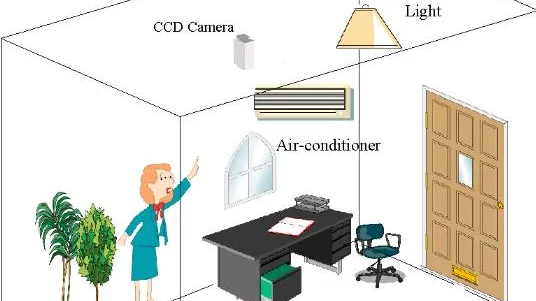
Support of Intelligent Rooms by Image Processing
In recent years, rooms with intelligence are studied. This kind of rooms is becoming important not only for medical or welfare use, but also at offices or ordinary houses. Obviously, the man-machine interface to communicate human intention is a subst…
Show full Story
HALCON
Education, Research & Science
Classification
Filtering
MVTec HALCON product icon
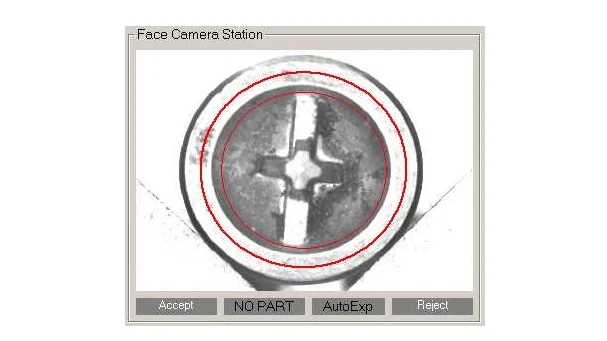
Machine Vision Solves "Needle-in-a-haystack" Problem for Small Parts Manufacturer, Developed by Data Systems
Data Systems solves the “needle-in-a-haystack” challenge for a small parts manufacturer using HALCON-based machine vision. The system automatically inspects, sorts, and classifies over 300,000 part variations, checking size, type, coating, and laser…
Show full Story
HALCON
Machinery
Packaging & Logistics
Matching
OCR
MVTec HALCON product icon
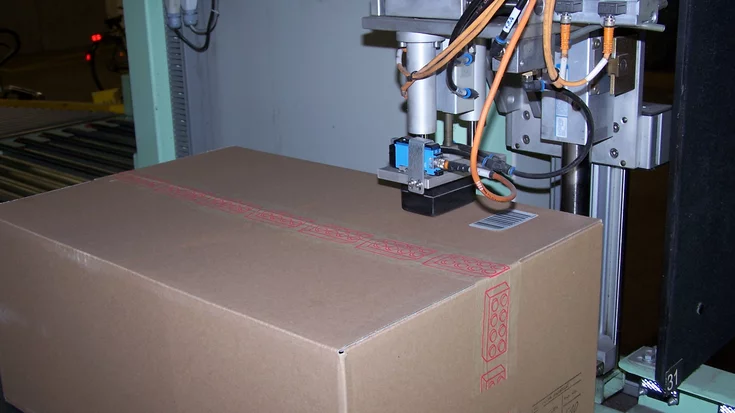
Package label with barcode and printed text used for automated barcode reading and OCR.
Machine Vision Speeds Package Bar Code Reading at Quelle GmbH
At Quelle GmbH's logistics center in Leipzig, 80,000 packages are processed daily. To enhance efficiency, the company employs a combined machine vision system with barcode reading and OCR. Utilizing Baumer i-Cam 108 cameras and MVTec's HALCON softwar…
Show full Story
HALCON
Machinery
Packaging & Logistics
Bar Code & 2D Code Reading
OCR
MVTec HALCON product icon
Manual handling of a helicopter on a ship deck under rough sea conditions.
Automatic Helicopter Handling System from FHS Förder- und Hebesysteme GmbH
FHS Förder- und Hebesysteme GmbH is a leading supplier of defense technology and naval technology. The company has a long experience and competences in development and production of systems and machines with electrical hydraulical drives and control…
Show full Story
HALCON
Robotics
Calibration
Measuring
MVTec HALCON product icon
The Presetter and Measuring Machine SATURN from Zoller – Measurement of Tools with HALCON
The ZOLLER SATURN measuring machine employs HALCON for precise tool measurement in the micrometer range. Subpixel algorithms automatically extract geometric properties from the tool shape. Camera calibration ensures consistent precision across the en…
Show full Story
HALCON
Machinery
Calibration
Measuring
MVTec Software