
WORKFLOW
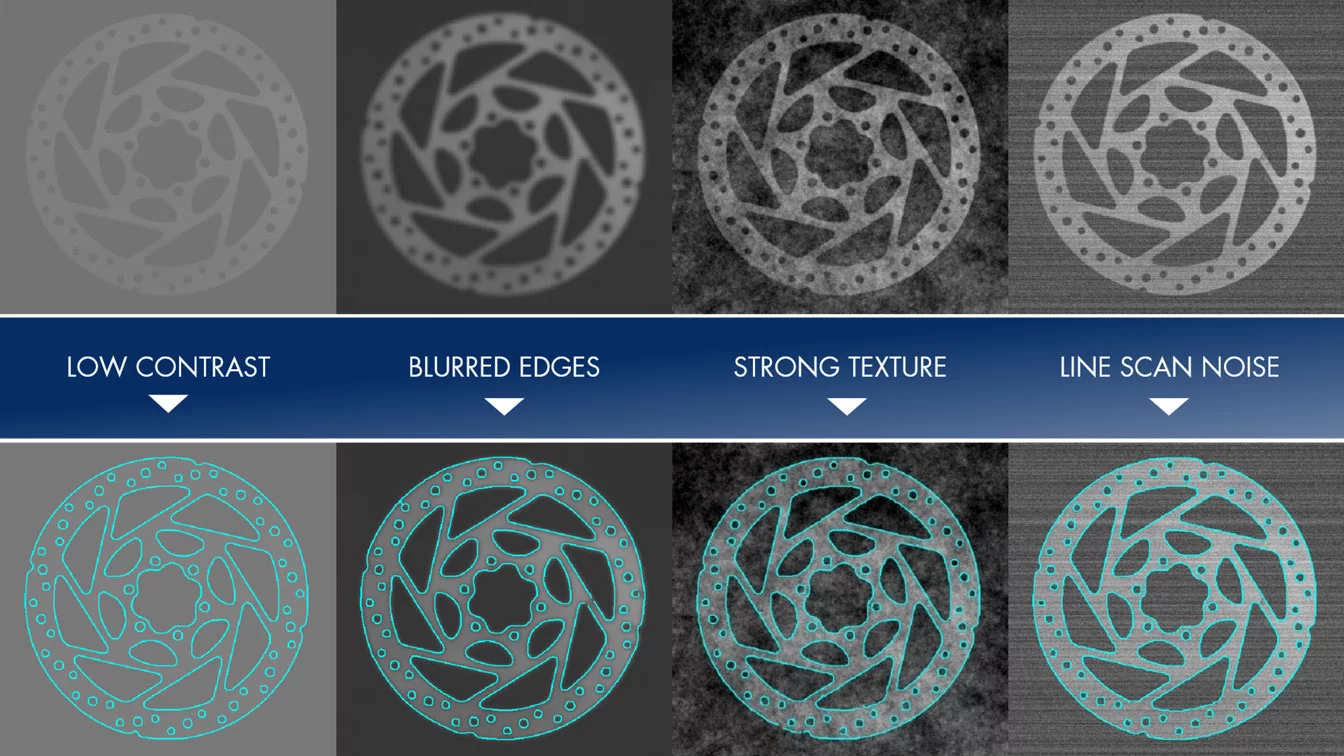
The deep learning model is trained with a small number of images to specifically recognize edge structures. This enables the model to quickly respond to new requirements or changes in the image environment.
The pre-trained model can extract edges in image areas with low contrast and significant noise, where traditional edge detection algorithms would fail.
The deep learning method extracts only the relevant edges, significantly reducing programming effort since manual specification of edge features is not required.
EDGE EXTRACTION
High accuracy – Precise extraction of edges, even under poor image conditions (low contrast, noise).
Automatic adjustment – Training with minimal effort, without the need to manually define features.
Efficient processing – More robust edge detection, even for edges that are inaccessible to traditional edge detection filters.
Quick integration – Directly integrable into HALCON – ideal for industrial image processing and real-time inference.
EDGE EXTRACTION
In the automotive industry, edge extraction is used to identify solder joints or cutting edges on components. The model detects even weak edges, making it highly efficient for quality control.
In the packaging industry, label edges or seams of packaging can be automatically extracted and checked for defects, even with complex or irregular shapes.


