BOUNDING BOXES
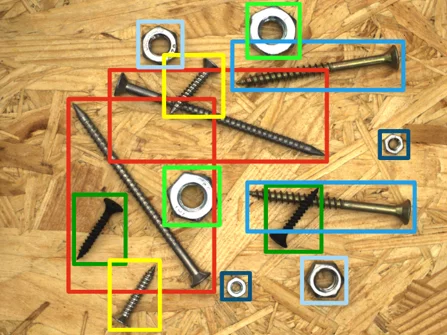
The deep learning algorithm creates a bounding box for each detected object that surrounds the object.
These boxes define the position and size of the objects in the image.
In addition, a predicted class is assigned to each object, for example “coffee,” “milk,” or “defect.”
In HALCON and MERLIC, the bounding boxes can also be adapted to the orientation of the object.
This leads to more precise detection, as the boxes are optimally adapted to the shape of the object.
To train a model, labeled data in the form of bounding box coordinates must be provided.
This enables the deep learning model to detect different object instances and classify them with high accuracy.
PRECISION & ADAPTABILITY
Automatic object detection: Objects are localized accurately, even if they overlap or are partially occluded.
Precise classification: Detection is performed with high accuracy, as the class and position of the objects are determined.
Adaptable orientation: The possibility of adapting the bounding boxes to the orientation of the objects further improves detection accuracy.
Low effort: The training effort is minimized through automatic feature learning and fewer manual interventions.
REAL-WORLD USe CASES

In the food industry, coffee packages or other product packaging can be detected and counted, even if they overlap or are placed close together.
Deep learning technology ensures that each package is localized and classified correctly.
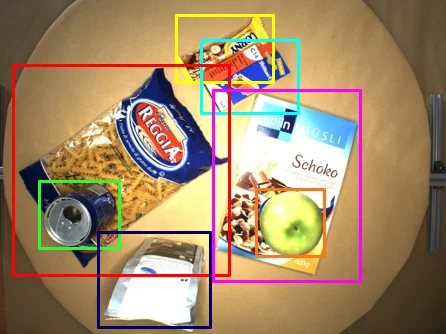
Deep-learning-based object detection can also be used in logistics to detect and count different food packages or product packaging.
This is an essential step for automated inspections and quality control.