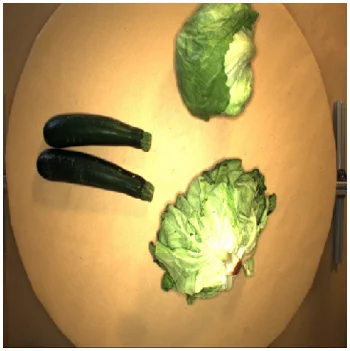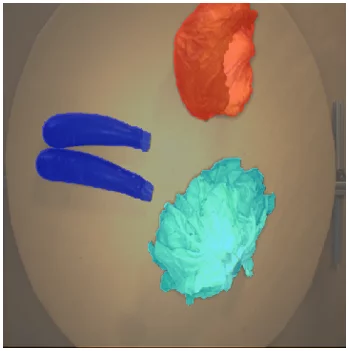
During model training, a sufficient amount of training data is used to learn pixel-accurate classifications. The model learns to predict, for each pixel in the image, which class it represents (e.g., “good,” “defective,” “background”). For each predicted pixel, a confidence score is also calculated to indicate the reliability of the classification.
IN HALCON & MERLIC
With minimal effort, even hard-to-detect defects are identified with pixel-level accuracy.
Models can be trained with minimal parameterization for complex inspection tasks.
High reliability of classifications, supported by a confidence score for each predicted pixel.
Especially useful for real-time use in inline inspections or under changing production conditions.
In the food industry, semantic segmentation can be used to precisely distinguish different types of vegetables on a conveyor belt. The method classifies the different vegetable types at pixel level and separates them for further processing.
The technology can be applied to components in electronics manufacturing to distinguish defective parts from intact parts and automatically mark faulty components.