Success Story
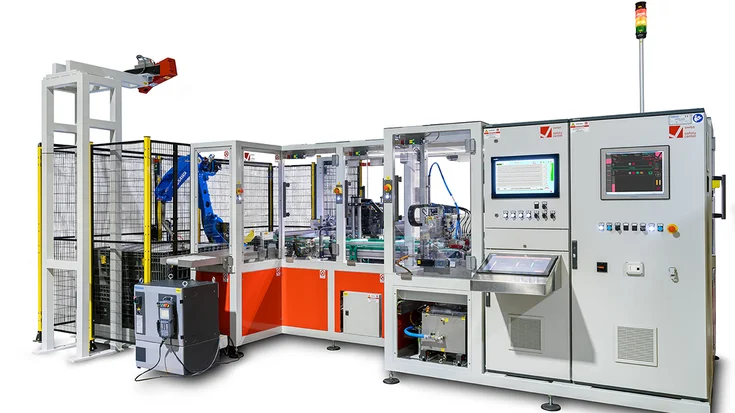
How can sealants be applied accurately and consistently to large components with complex geometries? French robotics specialist AKEOPLUS has developed an automated robotic cell that replaces a previously manual process in aerospace manufacturing. Using MVTec HALCON machine vision software, the system determines the actual position and orientation of the components and adjusts the robot's movements accordingly. This enables sealant beads to be positioned with an overall accuracy of ±0.2 mm, even within a workspace measuring approximately two meters in each dimension.

Applying sealants to aerospace components requires exceptional care. Sealant beads must follow the intended paths accurately and consistently to ensure a reliable seal. This becomes particularly challenging when dealing with large components that vary in shape and configuration.
An aerospace manufacturer therefore wanted to automate a process that had previously relied on manual work. The application involves applying a primer followed by a two-component sealant to bronze or stainless steel bearings installed in painted metal parts. The manual process was not only labor-intensive but also time-critical, as the prepared sealant hardens after approximately two hours. In addition, handling the materials could expose employees to potentially harmful substances.
To surmount these difficulties, AKEOPLUS, a French company specializing in customized robotic solutions, was commissioned to develop an automated system. The main challenge was to accommodate different components within a large workspace while maintaining the required accuracy. Although the parts are mechanically pre-positioned, their actual locations may still deviate by several centimeters. Sealant application, however, requires an overall positioning accuracy of ±0.2 mm.

Achieving this level of precision through mechanical positioning alone would have required additional process steps and more physical contact with the components. AKEOPLUS therefore chose an approach based on 3D machine vision.
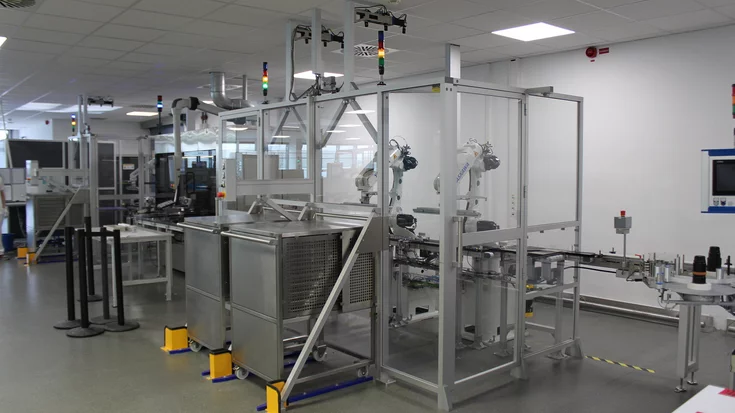
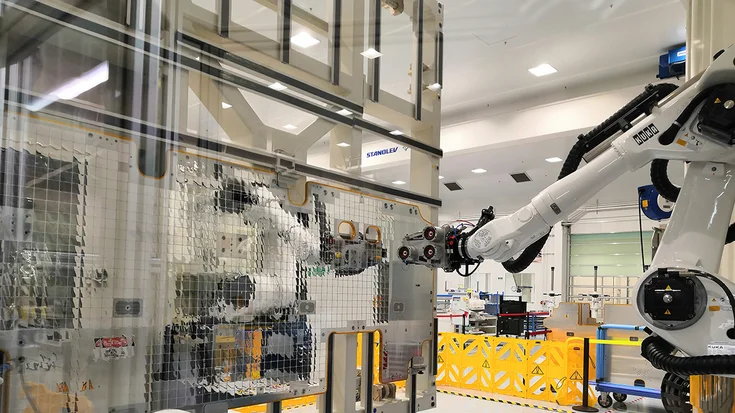
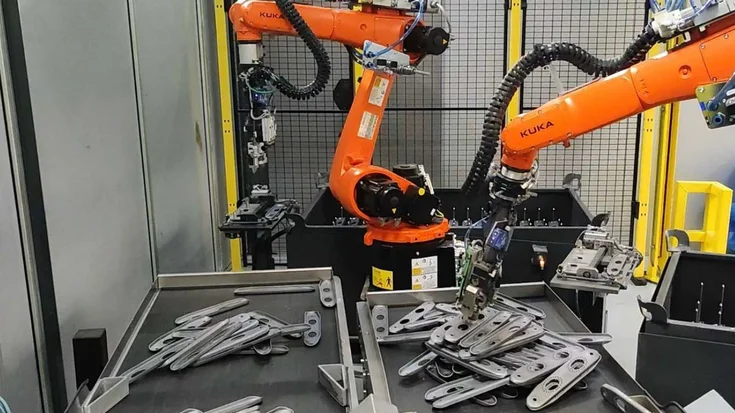
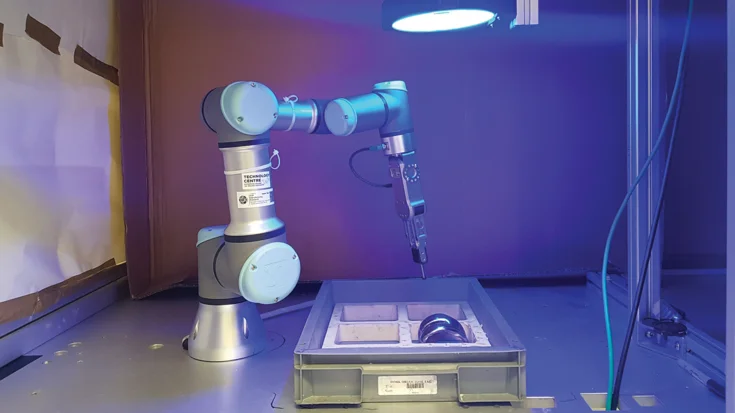
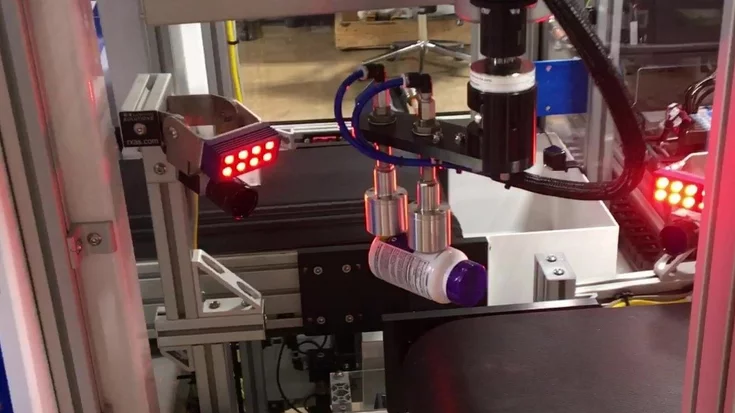
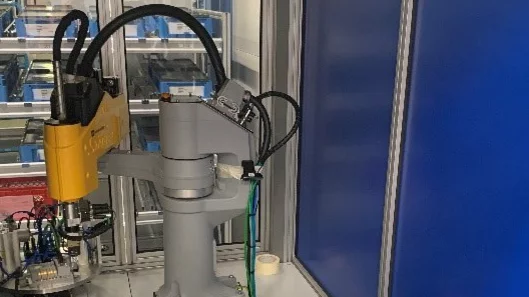
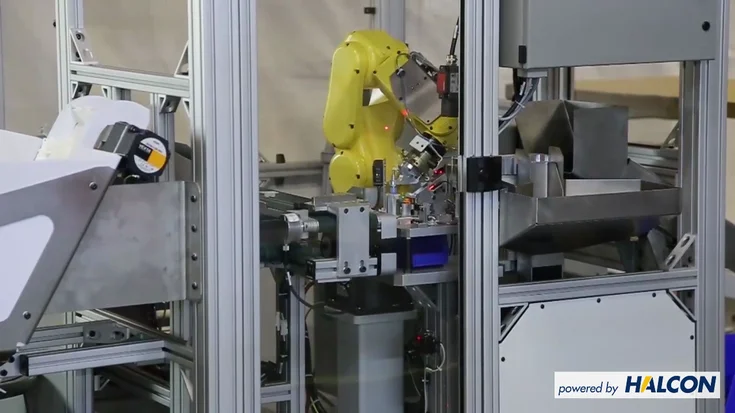
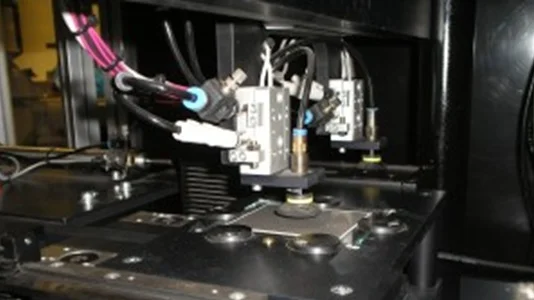
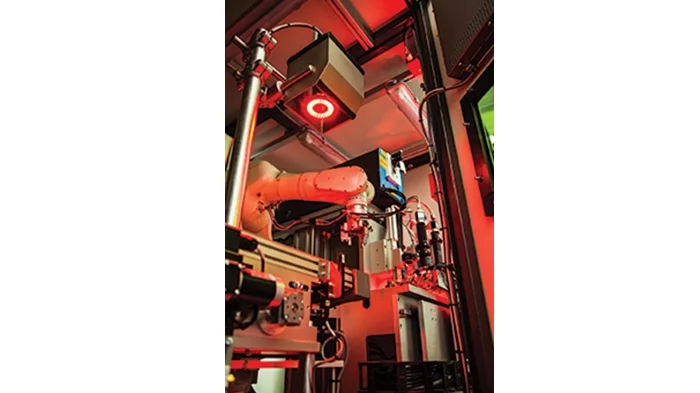
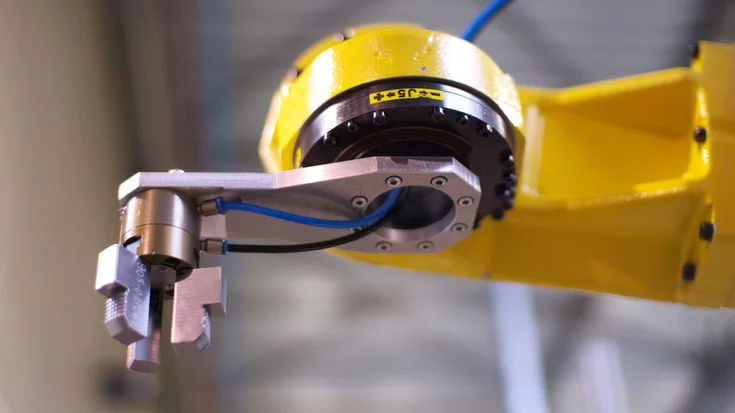
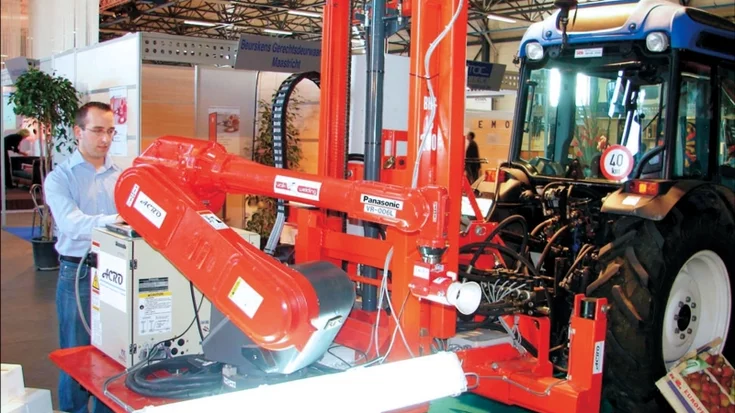
The robotic cell combines a six-axis robot with a 3D profilometer, a dispensing system for primer and sealant, and sensors for process monitoring. Machine vision plays a central role by determining the actual position of the areas to be processed and providing the information needed to adjust the robot's programmed paths.
At the beginning of the process, the tools and consumables are prepared before the component enters the workspace and is roughly positioned. The robot then uses the 3D profilometer to scan the designated areas, including the bearings around which primer and sealant will be applied.
The captured 3D data is processed by the machine vision software to determine the position and orientation of the bearings. Based on this information, the system adjusts the programmed robot paths to match the actual component geometry. After scanning, the robot switches to the primer application tool and subsequently to the sealant dispensing nozzle. Its speed along the calculated path is adjusted according to the required bead thickness.
One of the main technical challenges lies in coordinating the various system components. The robot, 3D profilometer, calibration system, and other sensors each introduce their own tolerances. These deviations must be carefully controlled to achieve the required overall accuracy.
“The special challenge was therefore to derive a precise robot path from a variable component. This is exactly where 3D machine vision demonstrates its strength. It compensates for manufacturing, assembly, and operator influences and makes the robot-assisted process possible in the first place,” explains Maxime Motisi, an engineer specializing in robot-assisted dispensing applications at AKEOPLUS.
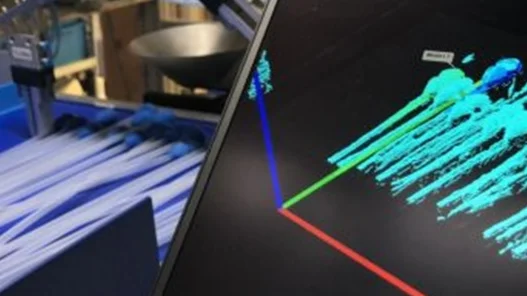
AKEOPLUS uses MVTec HALCON as the machine vision software component of the application. HALCON processes the data acquired by the 3D profilometer and enables precise localization of the bearings in three-dimensional space.
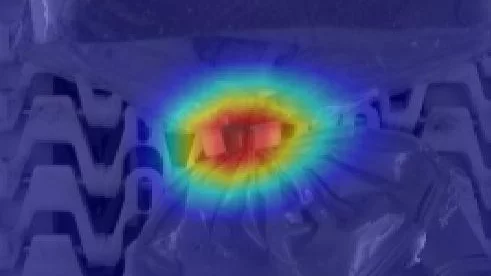
To achieve this, the system converts X, Y, and Z images into 3D point clouds and combines 2D and 3D image processing methods. It also uses CAD data and 3D object models to determine the six degrees of freedom of the bearings. This allows the system to identify their actual position and orientation, even when their geometries and dimensions vary.
“MVTec HALCON offers many functions that are crucial for robot-assisted applications using 3D data. These include robust 3D methods, 3D objects models, the combination of 2D and 3D processing, and the ability to efficiently integrate complex machine vision logic into industrial processes. Especially for applications with high accuracy requirements, this combination is a decisive advantage,” explains Jan Gärtner, Product Manager HALCON at MVTec.


Beyond its image processing capabilities, HALCON also supports efficient development and integration. AKEOPLUS developed the application using the HALCON library as well as the integrated development environment HDevelop. Through HDevEngine, the scripts can be called directly from AKEOPLUS's AkeoSpine framework, eliminating the need to reimplement the machine vision logic for production.
HALCON also simplifies the configuration of new bearing geometries. A custom wizard guides operators through the setup of the required 3D surface models and parameters. During operation, the system uses these models to locate the bearings based on the current 3D scans. HALCON's hardware independence provides additional flexibility when adapting the robotic cell to different customer requirements.
“For us, it is important that our vision engineers can work very autonomously. With HDevelop, the HALCON library, and the visualization options, we can develop, test, debug, and integrate the application into the overall process. This reduces interfaces and accelerates implementation,”
says Motisi

The robotic cell has been in operation since spring 2026. Initial results have impressed the customer: The system applies uniform, thin, and consistent sealant beads, making a previously manual manufacturing process more reproducible.
At the same time, automation reduces manual effort and limits employees' direct exposure to the materials used. By combining robotics, dispensing technology, and industrial machine vision, the solution supports precise manufacturing while improving working conditions.
For AKEOPLUS, the project demonstrates the potential of combining 3D machine vision with robotics in aerospace manufacturing. Even complex processes that previously depended on human experience and manual precision can be automated when the actual component geometry is reliably captured and translated into accurate robot movements.
REAL-WORLD APPLICATIONS