Success Story

3D vision enables robots to “see” in the carpentry industry

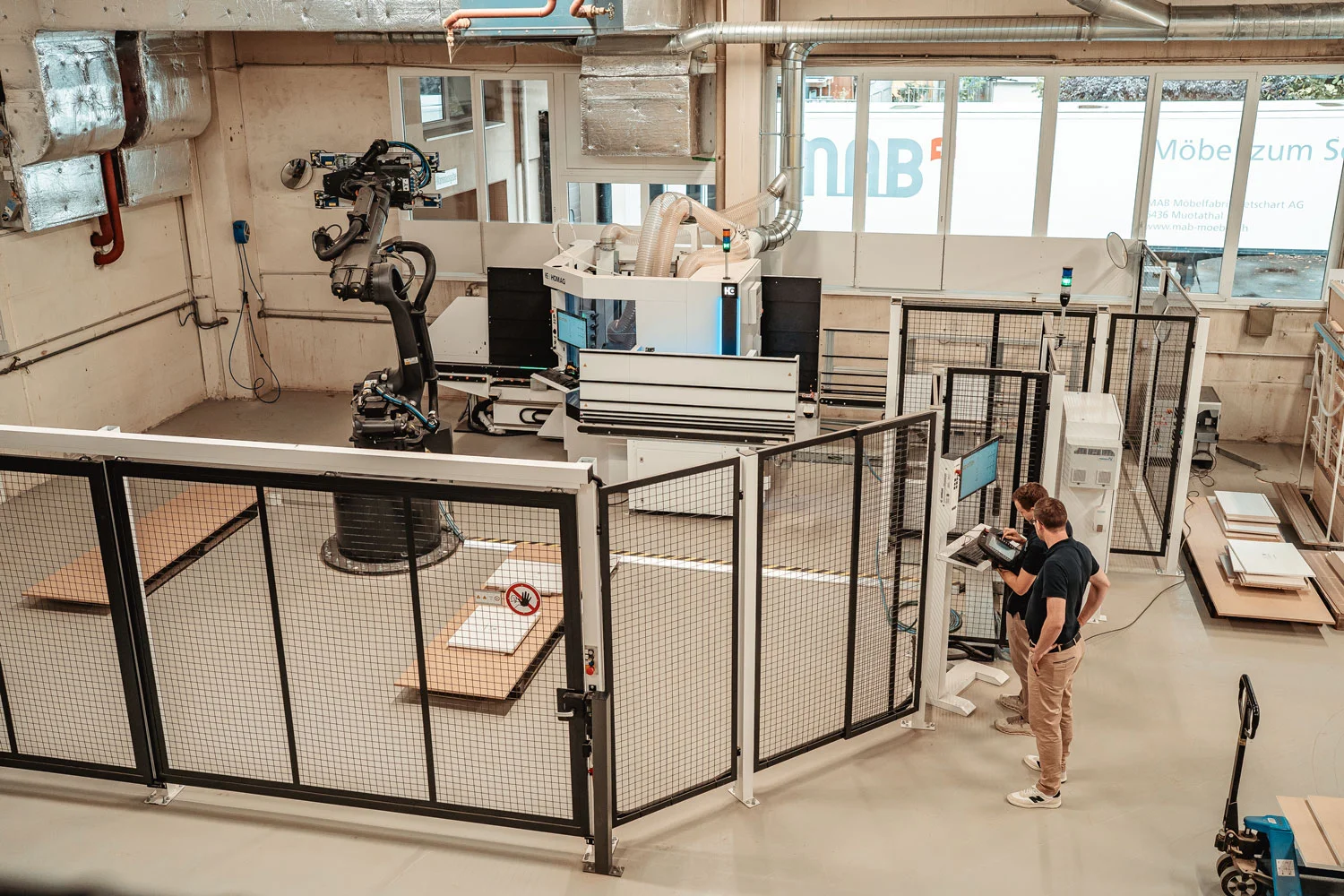
As in many industrial areas, automation is advancing in furniture production as well. One example of this is MAB Möbel AG from Switzerland: with the support of HOMAG Bohrsysteme GmbH and MVTec Software GmbH, this furniture manufacturer automated the loading process around a vertical CNC machining center with robotic handling. Using MVTec HALCON, a robot picks up wooden workpieces from a chaotically arranged stack, feeds them to the machining center, and removes them after processing.
HALCON
Machinery
Robotics
3D Vision
OCR

Like other industries, the woodworking sector faces challenges such as quality assurance, untapped efficiency potential, and a shortage of skilled workers. Automation can reduce errors, improve quality, and increase efficiency. It allows 24/7 production, performing tasks faster and more precisely than humans, freeing up human resources for other tasks.

HOMAG Bohrsysteme GmbH developed a solution to address these challenges. The company, part of the HOMAG Group, offers high-tech machines for the woodworking industry. Its solution automates loading a vertical CNC machining center. At the heart of the system is a robot that picks up workpieces from a stack, feeds them to the CNC machine, and correctly places them after processing. The key challenge here is that the workpieces are unique, and their shape and size are unknown, arranged chaotically. Additionally, each workpiece must be drilled individually. The relevant information is stored in a barcode on the workpiece, meaning this code must be read as well. Machine vision enables the process to be fully automated. MVTec HALCON allows the robot to recognize and safely grasp the workpieces while also reading and sending barcode data to the CNC machine for drilling the correct holes.

The requirement: to fully automate a labor-intensive process step

HOMAG’s fully automated system is used at MAB Möbel AG’s carpentry workshop in Muotathal, Switzerland. The company has produced quality furniture since 1951 based on ecological and design-oriented principles. "The further development of the cell with laser scanning and chaotic stacking was the function we had been waiting for," explains Luca Zingg, responsible for corporate development at MAB. "This allows the cell to meet our goal of batch size 1 production – and only then does automation make sense for us."

Previously, an employee manually loaded the CNC machine, scanned the barcode, and placed the workpieces. This repetitive task became physically demanding and inefficient. Tobias Schwarz, Senior Director of Product Development at HOMAG, explains: “MAB aimed to increase productivity, deploy employees more effectively, and reduce costs. Full automation also eliminates the need to sort workpieces before processing, saving time and increasing productivity.”

The challenge now was to create a new solution, as no similar system existed. The machine vision system faced difficulties due to workpiece diversity and different surface decors. Additionally, the system had to operate under ambient light, and the relatively flat boards needed to be reliably separated. "The implementation was technically challenging. But with MVTec HALCON, we were able to find a feasible solution that combines speed and precision," explains Schwarz.
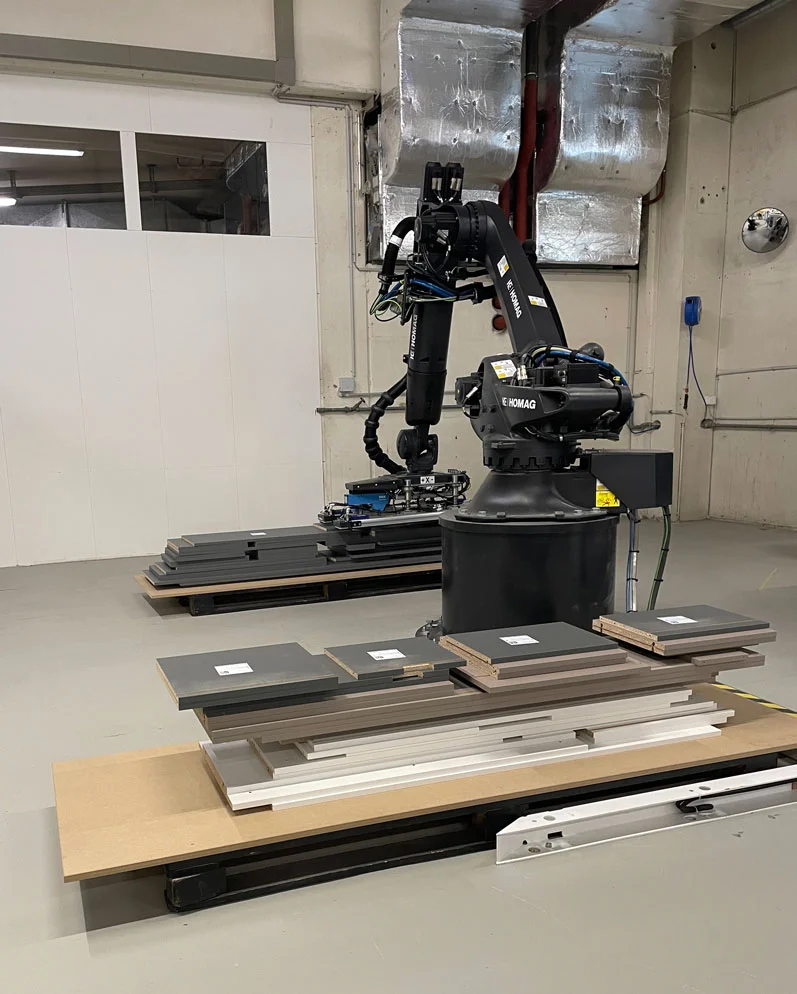
3D point cloud enables the robot to recognize workpieces

The application uses several hardware components, including a six-axis robot with a vacuum surface gripper and a 3D laser scanner mounted on the gripper arm. The drilling operations occur in the DRILLTEQ V-310 CNC machining center from HOMAG. Regarding machine vision software, Tobias Schwarz says: "We have been using MVTec HALCON for quite some time. The software offers a large pool of machine vision operators and can be flexibly combined with various hardware components."

At MAB, the process works as follows: an employee places wooden workpieces onto a chaotic stack. The robot moves over the stack, and the 3D laser scanner scans it from above. From this, the scanner creates a 3D point cloud, a precise 3D representation. After image acquisition, MVTec HALCON extracts the top layer and determines the spatial position of each workpiece. A stacking algorithm calculates the optimal withdrawal sequence to avoid the stack from collapsing. The robot removes the workpieces in the calculated order and transfers them to the CNC machining center. The 3D laser scanner also captures a 2D image of the barcode, which HALCON reads and sends to the machine for processing. Afterward, the robot places the processed workpieces onto the target stack.
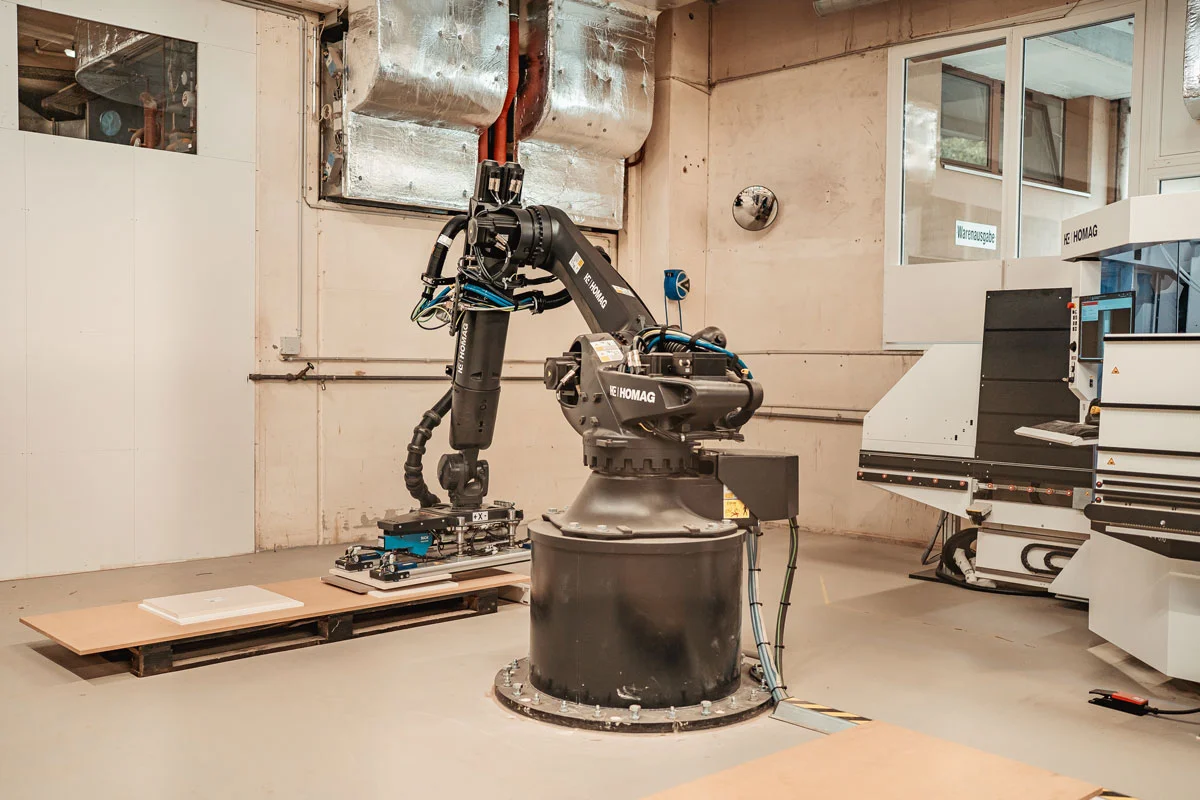
MVTec HALCON performs multiple machine vision tasks

“Machine vision is gaining popularity in the woodworking industry. And our software MVTec HALCON offers numerous methods for inspection tasks and  collaboration with robots. Consequently, it sustainably supports automation in this sector,” says Jan Gärtner, Product Manager HALCON at MVTec.

For the robot at MAB to work autonomously, MVTec HALCON performs several tasks. First, it converts the 3D point cloud into usable data. Using 3D object models, HALCON creates a coordinate system that is sent to the robot. Several HALCON operators determine the distance of the gripper to the pallet, calculate the top layer, and the position of each workpiece. These positions are integrated into the coordinate system and sent to the robot.

The 3D scanner also captures 2D images, which HALCON uses to read the barcode information on the workpieces. "The implementation wasn’t trivial due to the flat boards. We combined 2D and 3D vision methods, which was easily possible with HALCON,” Schwarz explains.

System completed in summer 2025

The system was put into operation at MAB Möbel AG in the summer of 2025. “Thanks to close collaboration with our partners, we were able to achieve very good results right from the start. Today, the system runs reliably, and we are confident that we can further increase our automation this way,” explains Luca Zingg.

“The additional level of automation significantly relieves MAB, as employees can now focus on other tasks. For us, this also represents an important development, as we can increase the automation level of our base machines and provide added value to our customers”, adds Tobias Schwarz.
Further articles

Visualize Object Model 3D
Improve your surface-based matching with two helpful features
Do you sometimes have objects, which have rather small symmetry-breaking elements (such as small boreholes on an object)? Does your surface-based 3D matching not find the correct orientation?
Read more
Developers Corner
Deep OCR Interface
Deep OCR recognition training – the next level
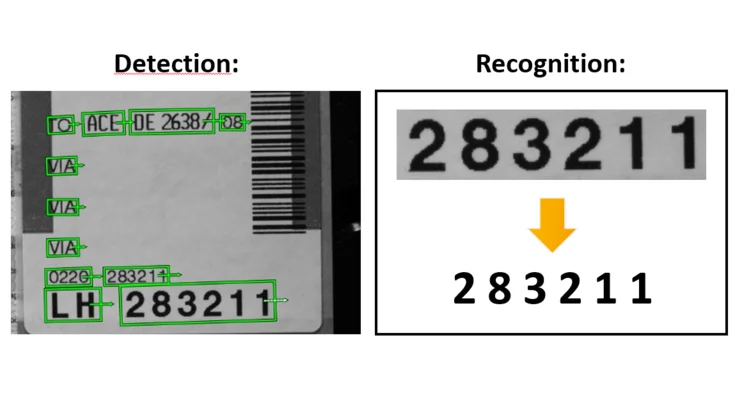
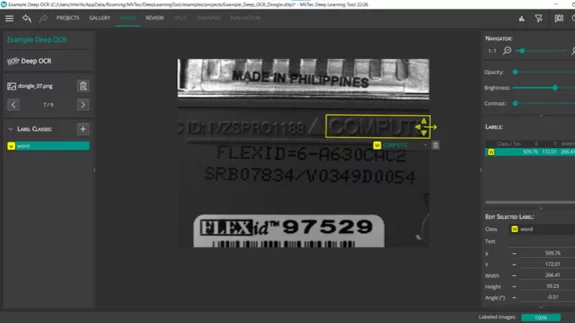
HALCON’s Deep OCR is very powerful and can detect and recognize text in various industrial scenes. However, what if you have a special font, or want to read foreign characters? With HALCON 22.05 it is possible to train the recognition model to read s…
Read more
Developers Corner
Fitted primitives distance threshold
Metrology Model – Quality of Fit
"For most applications, the standard parameter values are sufficient." This sentence is often read in the HALCON Solution Guide. But what if the results do not meet your expectations? The Metrology Model allows lightning-fast measurement of geometric…
Read more
Developers Corner
Review of Acquisition Modes
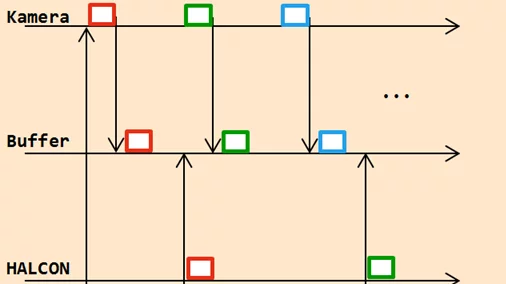
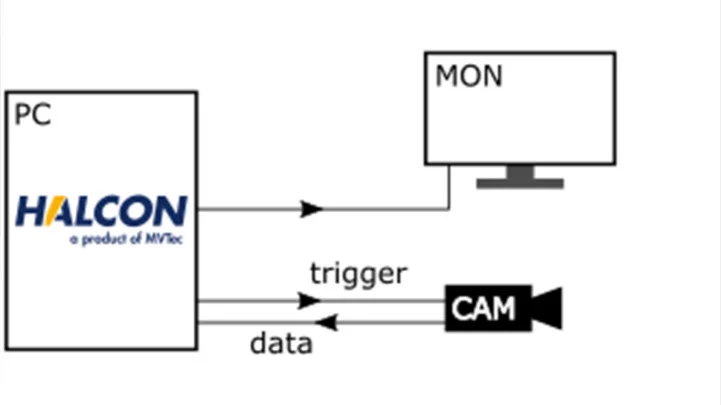
This article gives an overview of HALCON’s image acquisition modes, explaining how continuous, triggered, and synchronous acquisition work, and clarifying common misconceptions for practical applications.
Read more
Developers Corner
Deep OCR – Tips and Tricks
Have you already experienced the performance boost by using Deep OCR compared to the classical rule‑based approaches? In this article, we’ll show you practical tips and tricks to further improve your Deep OCR results.
Read more
Developers Corner
Easy text and code reading with MERLIC standard tools
If you want to build an MVApp that reads for example QR codes or bar codes you can do so with just a few clicks. You can even combine the tools to get all available information printed on a product in different formats without the need for programmin…
Read more
Developers Corner
About MVTec's Heatmap
Imagine you intend to deliver a HALCON deep-learning-based classification application. And you are about to evaluate a trained model. You are therefore looking for feedback about this model, i.e. about its performances, biases, and other possible def…
Read more
Developers Corner
Gabor filter: What is it for?
Gabor filters, which are well known in the realm of time series analyses, can also be used in HALCON for 2D image analysis. They are particularly useful for detecting textures, patterns, and orientations in complex images.
Read more
Developers Corner
Introduction to new sub-pixel feature of bar code reader
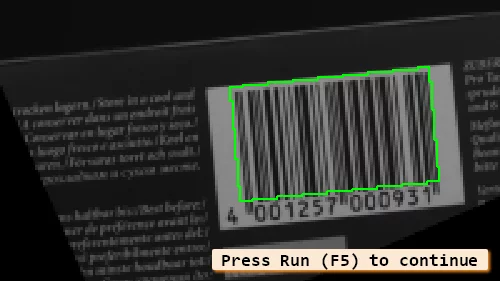
Do you have small resolution bar codes to read but don't get any good results? Then please try our new feature – the subpixel bar code reader.
Read more
Developers Corner
Introduction to XYZ-Mappings (part 2)
This technical article continues our introduction to XYZ-mappings. In the last article, we answered the question "What are XYZ-mappings?" and gave a short preview towards "Why is using XYZ-mappings beneficial for many 3D applications?". Today, we wil…
Read more
Developers Corner
Introduction to XYZ-Mappings (part 1)
This technical article explores the benefits of XYZ-mappings in HALCON, showing how they increase speed, flexibility, and ease of use for many 3D applications.
Read more
Developers Corner
Deep learning: Why is the dataset key for a success result?
Deep learning success starts with the dataset: Learn why acquiring high-quality, well-labeled training data is crucial for reliable classification, detection, segmentation, and anomaly detection in your machine vision applications.
Read more
Developers Corner
How to prepare 3D height images for further processing with MERLIC’s standard tools
Learn how to prepare 3D height images in MERLIC for further processing: convert non-byte images to byte images to enable alignment, embossed text reading, and defect detection with standard easyTouch tools.
Read more
Developers Corner
Deflectrometry demo HALCON
Inspection of specular surfaces with deflectometry in HALCON
Inspect flat and curved reflective surfaces quickly and reliably with HALCON deflectometry: detect scratches, dents, and other defects with synchronized image acquisition and flexible image processing.
Read more
Developers Corner
Deep Learning classifier HALCON
Training a deep learning classifier with HALCON on the embedded board Jetson TX2
Learn how to train a deep learning classifier with HALCON on both a PC and an embedded Jetson TX2 board, from image acquisition to model training and inference, for efficient machine vision applications.
Read more
Developers Corner
Add touch input to the HSmartWindowControlWPF
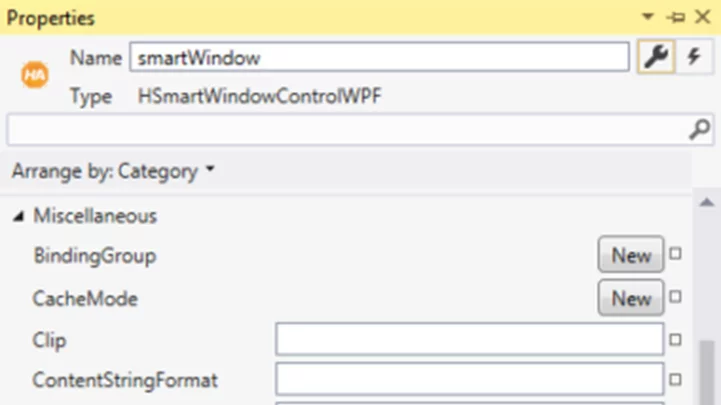
Learn how to easily add touch input, including pinch-to-zoom, to the HSmartWindowControlWPF in HALCON, leveraging WPF’s built-in multi-touch events for intuitive image control.
Read more
Developers Corner
Increasing Speed in Deflectometry Set-ups
Discover three approaches to increase speed in deflectometry setups, from simple software-based synchronization to hardware triggers and FPGA-based real-time control, enabling faster and more precise inspection of reflective surfaces.
Read more
Developers Corner
HDevelop matching assistant speedup greediness
Speeding up shape-based matching with "Greediness"
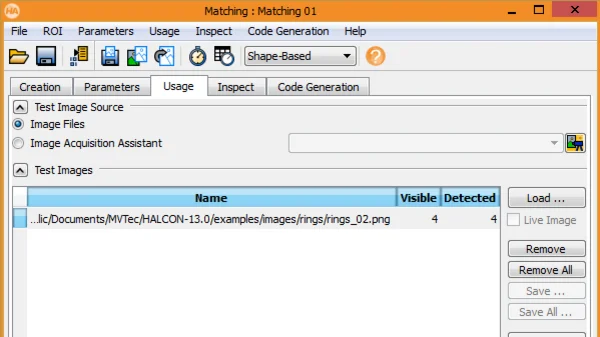
Learn how the 'Greediness' parameter in shape-based matching balances speed and detection completeness, enabling faster searches while maintaining robust results in HALCON.
Read more
Developers Corner
Best practice for classification and OCR
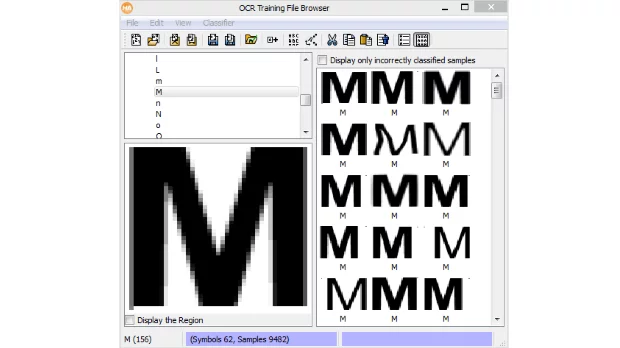
Discover best practices for setting up classification and OCR in HALCON using the HDevelop OCR Training File Browser – quickly review, correct, and optimize your training data to improve segmentation and classification results.
Read more
Developers Corner
Rejection all classes 1.5
How to use rejection classes in MVTec HALCON
Learn how to handle outlier samples in MVTec HALCON by using rejection classes in MLP classifiers – automatically generate samples outside the training classes to improve classification reliability.
Read more
Developers Corner
MVTec Software