Success Story
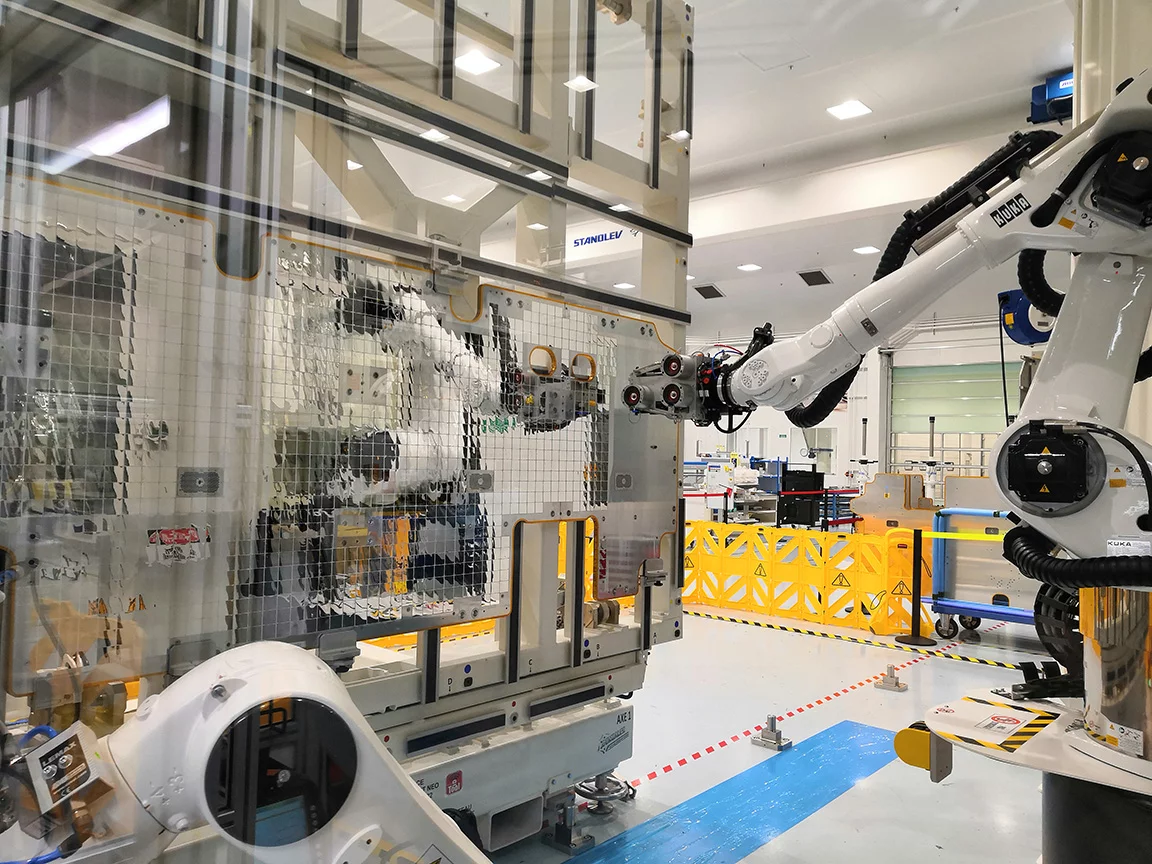
Increasing productivity, relieving humans of physically demanding tasks, and improving quality - these are the major benefits of robot-based automation combined with machine vision.
A specialist in the implementation of robot-based automation solutions in combination with machine vision is the French company AKEOPLUS. Founded in 2006 and based in Château-Gaillard, the company is considered a pioneer in the field of robotics.
A system that combines the strengths of robotics and machine vision was developed at AKEOPLUS, in coordination and on behalf of Thales Alenia Space. Thales Alenia Space is a global space manufacturer delivering high-tech solutions for various industries. Together with AKEOPLUS they developed a robotic solution for manufacturing satellite panels.
In the cell called "SOLAR", robots fit optical solar reflectors (OSR) to satellite panels. The development task was to enable the robots to apply the up to 7,000 40 by 43 millimeter OSRs to the 6 by 3 meter panel with an accuracy of less than 0.2 millimeters under clean room conditions. The ratio of positioning accuracy to the size of the work area was a major challenge in implementation. To meet the requirements, AKEOPLUS relied on MVTec HALCON machine vision software to assist with inspection tasks and alignment of the OSRs.
In the cell called "SOLAR", robots fit optical solar reflectors (OSR) to satellite panels. The development task was to enable the robots to apply the up to 7,000 40 by 43 millimeter OSRs to the 6 by 3 meter panel with an accuracy of less than 0.2 millimeters under clean room conditions. The ratio of positioning accuracy to the size of the work area was a major challenge in implementation. To meet the requirements, AKEOPLUS relied on MVTec HALCON machine vision software to assist with inspection tasks and alignment of the OSRs.
OSRs are used in the space industry, for example to protect satellites in geostationary orbits from heat. Until now, the OSRs were mounted to the panel purely manually. Two or more workers had the task of positioning the OSR stripes and ensuring they were correctly aligned.
"Working on the panels was not ideal for the employees for ergonomic reasons. Therefore, we decided to automate the whole process. The robotic cell has been designed to speed up the process and thus increase productivity. Our customer can now manufacture much faster," explains Maxime Motisi, Chief Operating Officer and project manager of the SOLAR robotic cell at AKEOPLUS.
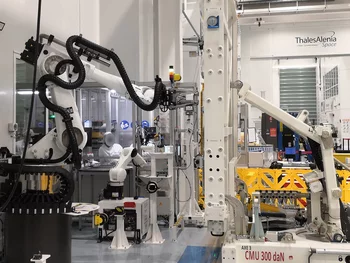
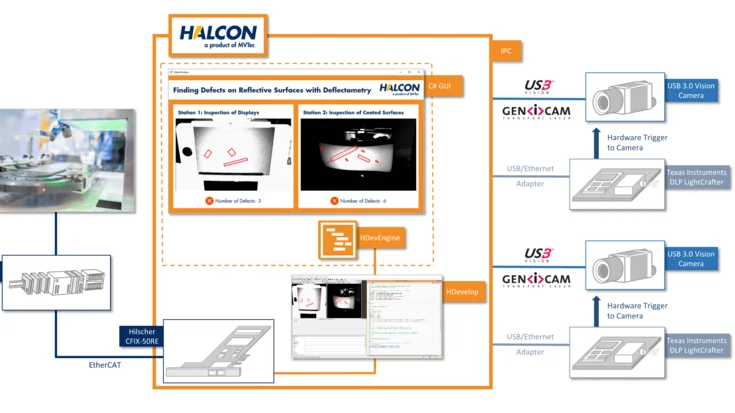
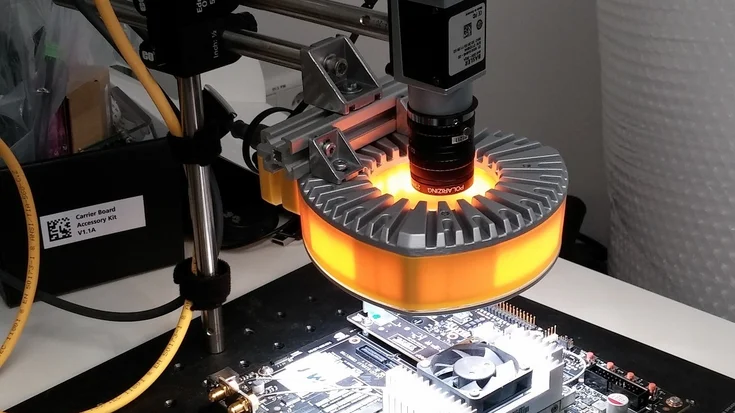
For the new automated production process, AKEOPLUS has designed the SOLAR robot cell jointly with Thales Alenia Space. Two robots are integrated into it, as well as a positioning table on which the satellite panels are placed. A laser tracker is responsible for absolute accuracy guidance of the 6 axis robotic arm and for industrial image processing three high-resolution 2D cameras are used on the hardware side. The HALCON machine vision software is responsible for the quality inspection of the OSR, fine positioning, human-machine-interface and visualization.
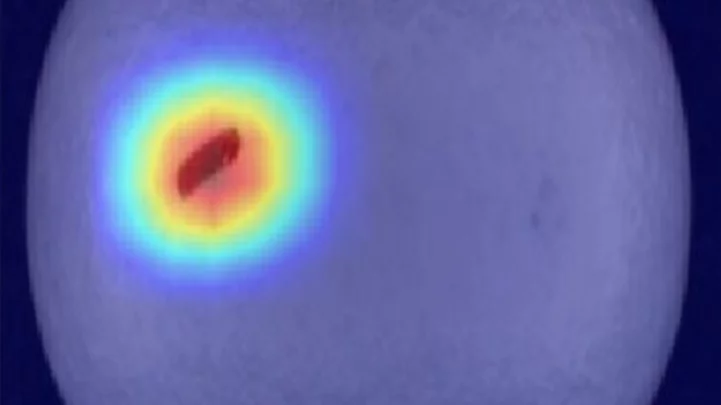
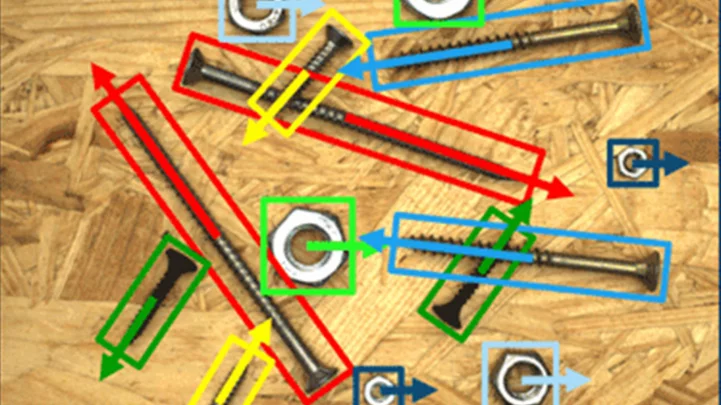
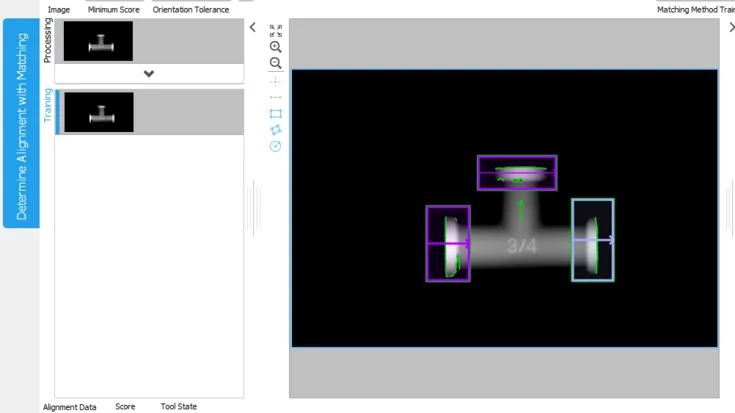
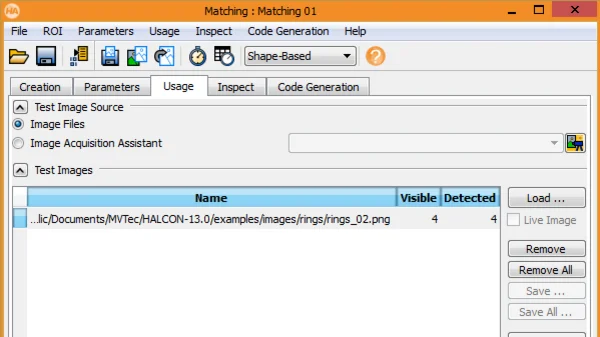
The manufacturing process is as follows: the small and fast robot places an OSR on a vacuum backlight under the first camera station. The picture is inspected for breaks and scratches using HALCON. In addition, the machine vision method "Shape-based Matching" is used to determine the exact position of the OSR and to check whether the size and shape of the component correspond to the intended model.
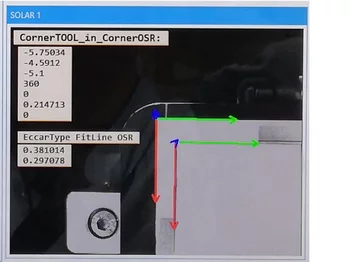
The OSR is aligned using machine vision in order to transport it to the next production step – with an accuracy close to 0.2 millimeters. When the component is "OK," glue is applied and the small robot picks it up and places it in a post so that the larger robot can grab it for further processing. The larger robot moves the part in front of the next image processing station, where HALCON analyzes the glue pattern and checks whether the glue is evenly distributed and respects a specific pre-defined pattern. This is followed by the precise alignment of the OSR to the arm of the robot at the third camera station by HALCON's algorithms determining the three-dimensional transformation between the coordinates of the OSR corner and the coordinate system of the robot’s gripper that holds the OSR by a vacuum gripping system.
The corners of the OSR are determined by the intersection of the edges. Derived from this, a coordinate system can be defined with the corner of the OSR as the center point, which is aligned with the edges of the OSR. The coordinate system of the effector robot was determined in advance by hand-eye calibration of the robot.
Determining the coordinate systems is important for two reasons: first, for 3D alignment as the reflector on the gripper might be tilted. Therefore, the corners of the OSR are compared with those of the effector, where each corner is known and hence acts as a reference point. Thus, even minimal tilts or shifts can be compensated. Secondly, the corner of the OSR serves as a reference point for placing to the panel.
With the support of the laser tracker and the HALCON machine vision software, AKEOPLUS has developed an iterative servoing process. This enables the robot to mount the OSR to the exact location on the 18-square-meter panel with the required accuracy and compensation for any inaccuracies.
"We have been working with MVTec as partners for many years. Therefore, we knew that with HALCON we have the powerful machine vision software we need for the SOLAR robotic cell," reports Maxime Motisi.
With the help of HDevelop, the development environment integrated in HALCON, seamless process integration is possible. Another important factor for the implementation was the speed and possibility to quickly develop or adjust powerful algorithms, which in turn can be easily integrated into the "host system". On the other hand, powerful machine vision software such as HALCON offers technologies to perform, for example, three-dimensional positional determinations or detect defective components. Subpixel-accurate Shape-based Matching is one of the most important technologies in this regard. When is comes to quality control, determining dimensional accuracy is also essential, in addition to checking for defects. Lastly, machine vision enables the subpixel-accurate measurement of edges along lines or circle segments in less than a millisecond.
“We can now be very satisfied with the result, because the requirements in terms of quality, productivity, and employee satisfaction were all achieved," says a pleased Maxime Motisi. In practice, this means that a large panel can now be completely covered with solar reflectors in five days with just one employee – at an OEE of >95%. Previously, it took around two employees and seven days to complete the same panel. In addition, the work environment for employees has greatly improved. A new quality assurance process was successfully introduced, namely checking the OSR for breakage and scratches.