MVTEC HALCON

Closing the Ring – NP Plastics

NP Plastics in the Netherlands manufactures small plastic rings used in binder closing mechanisms. To increase throughput and improve quality, the company deployed a machine vision system with two AVT FireWire cameras, LED illumination, and HALCON software. The system detects defects such as burrs or incorrect shapes from about 0.1 mm, processes roughly 600 parts per minute, and ensures each piece is fully inspected.
HALCON
Glass, Metal, Paper, Foil & Printing
Blob Analysis
Measuring

FireWire cameras, LED lighting, and software check for defects on plastic rings used to secure binders.

NP Plastics, a Dutch injection-molded plastics manufacturer, produces small plastic rings–among its many other products. These plastic rings are used in the closing mechanism of ring binders found in every office from Amsterdam to Hong Kong. To meet volume demand while improving quality, NP Plastics recently decided to install a machine-vision system to inspect the small plastic rings. The company turned to automation solution provider Radine with the support of Data Vision, Allied Vision Technologies' (AVT) sales partner in the Benelux. Data Vision developed a custom machine-vision solution using two AVT FireWire cameras, strobe and LED illumination, and MVTec Software GmbH's HALCON image-processing software running on a standard Dell PC to check the rings for burrs, undershots, and other spatial defects.

600 parts per minute

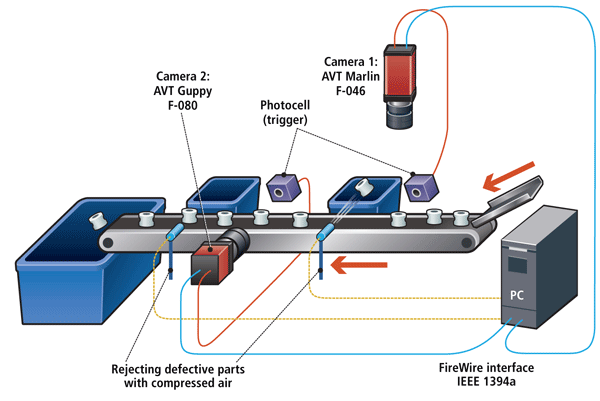
The plastic rings are fed into the inspection system by a PLC-controlled vibrating bowl feeder. The PLC and vision system communicate via digital I/O signals passed between the two machines that guarantee a supply of product is fed to the conveyor, and that the vision system is "active". The feeder orients the rings flat-side down and has a time-controlled gate that is configured to ensure that rings are spaced at a minimum interval of 40 mm on the inspection conveyor. At the maximum conveyor speed, this distance ensures that the machine-vision system will have 100 ms to acquire and process each image of each individual ring. Rings travel down the conveyor until they reach the first of two inspection stations. As the rings reach the side-view inspection station, a photocell mounted on the side of the conveyor triggers an AVT Guppy F-080 FireWire camera to acquire an image (see Fig. 1). "The smallest detail we need to detect is about 0.1 mm," explains Data Vision's machine vision engineer Robbert de Kraa. "Because we use a combination of blob analysis and measurement, we require four pixels minimum to robustly detect the smallest feature of 0.1 mm. With the field of view of 24 × 18 mm², a sensor is needed with a minimum resolution of 960 × 640 pixels. With a product rate of 10 products a second and some possible increase in the future, we selected an AVT Guppy F080B camera with a maximum frame rate of 30 frames/s and a resolution of 1032 × 778 pixels." FireWire was a good protocol selection, de Kraa explained, because of its high bandwidth and robustness against electromagnetic interference common to industrial environments. The side-view station looks for defects located around the edge of the plastic ring, including burrs on the top, bottom, and sides, as well as overshots that result in a rounded top or bottom rather than a flat ring.

In Table 1, the first row gives the type of defects, the second row specifies the range of the product where the defect is visible for the camera. The third row shows this range of the defect with arrows. The cross marks a defect. The fourth (bottom) row shows the defect in the camera view and the principle of detection in the image-processing algorithm. To minimize optical distortion at the edges of the camera's field of view while increasing contrast, de Kraa added a Jenoptik Jenmetar 0.2 × 12 telecentric lens and a TDB35 telecentric illumination lens fed by an optical fiber connected to a Volpi IntraLED 2020 white LED source to provide backlight illumination. The bright Volpi source allowed de Kraa to reduce the camera's shutter time to 200 µs, reducing the chance of blurring due to ring movement during exposure. The image from Station 1 is fed into the PC via an IOI Technology FireWire quadkaart. The MVTec HALCON software then takes over, using a combination of linear measurements and blob analysis to find burrs and other surface defects that exceed 0.1 mm. At the same time, a National Instruments PCI-6601 counter/timer card time-stamps the image, which represents the ring's location on the conveyor. Each inspection software application consists of two tasks. Task 1 takes care of the image acquisition and processing of the current product. The timestamp of each activity is then stored in a circular FIFO result buffer. This buffer contains result information for all the rings on the conveyor belt that have yet to pass the compressed-air rejection mechanism. Task 2 keeps track of the result buffer. It periodically (~ 1 ms) checks if there are still products in the buffer between camera and rejecter. If so, it takes the first pending unprocessed record and arms the hardware counter card with the time/counter stamp of the rejecter location, which is accurate to 10 ns. When the plastic ring reaches the rejecter location (e.g., when the hardware counter reaches the calculated exit location of this product), the timer/counter card fires the rejecter blower's solenoid. After the ring passes the rejecter position, this task finishes the current record and software increases the read pointer of the circular result FIFO. Since there is no physical connection between the application and conveyor belt by an encoder, the calculations are based on the speed setting of the conveyor belt. This approach simplifies the integration of the vision system with the material-handling system, making follow-up maintenance easier while reducing the bill of materials and system complexity.

Top-down approach

The plastic rings are also inspected by a vertically mounted camera. Minimum defect sizes for this station are 0.2 mm, allowing de Kraa to specify an AVT Marlin F033B camera with 656 × 494-pixel resolution with Pentax 50-mm entocentric machine-vision lens with 10-mm extension. For the top view, Data Vision designed a custom front illuminator using Luxeon (from Philips Lumileds Lighting Company) high-intensity red lumileds. The LEDs in a ring configuration are tilted inward slightly so that the top of the product as well as the borders are lit completely and evenly. The images are close to overexposure to cover the gray variation of the material and to get an even illumination in all cases. The LEDs are strobed to ensure a maximum of one pixel motion blur during exposure.
Again, the images are fed into the PC, and the HALCON software performs blob analysis and measurements to identify potential defects and classify the ring. Again, the National Instruments timing card tracks failed rings and triggers the air rejecter as necessary to separate bad parts from good (see Table 2).
The Radine/Data Vision system currently operates 24 hours a day. "We are especially proud of this sophisticated image-processing solution," says Bas H. Pot, who supervised the project at NP Plastics. "With this system, we can guarantee our most demanding clients that, even when millions of them are produced, each individual plastic roller that leaves our factory has had a complete check-up."

Author: Winn Hardin

Article kindly provided by Vision Systems Design.All product names, trademarks and images of the products/trademarks are copyright by their holders. All rights reserved.
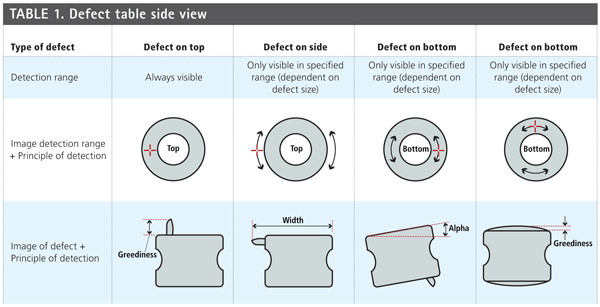
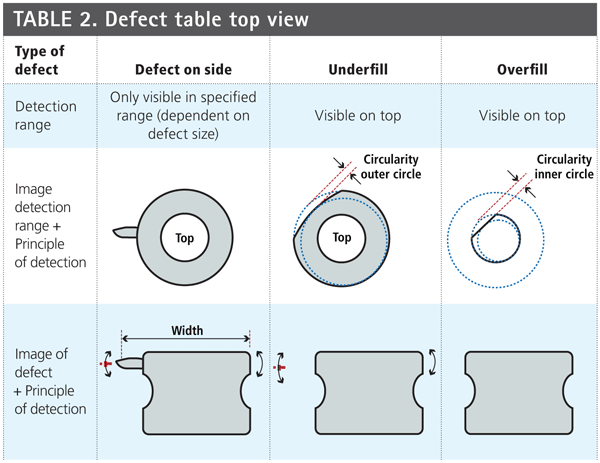
Table illustrating defect detection on plastic rings from different viewing angles using blob analysis.
Table 1
Table showing defect types such as underfill and overfill detected on plastic rings by machine vision.
Table 2

Published on: October 16, 2025
Further Success Stories

MVTec HALCON product icon
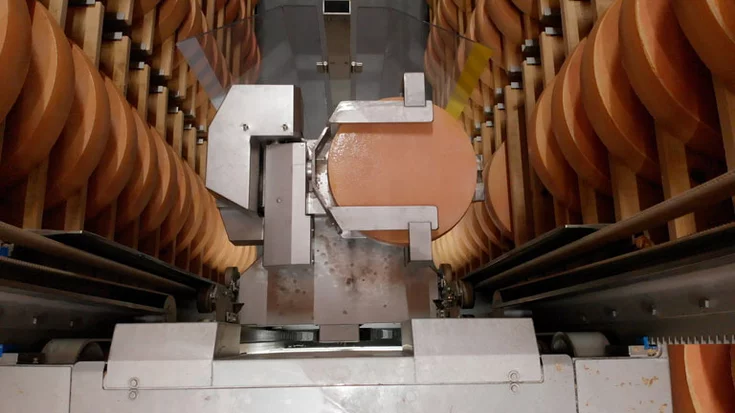
Warehouse where cheese wheels age during the ripening process
Revolutionizing Cheese Production with AI and Machine Vision
The food industry is experiencing a transformative shift in quality control, due in part to advances in artificial intelligence (AI). When combined with rule-based machine vision, AI is enabling automation of processes that were previously impossible…
Show full Story
HALCON
Food & Beverage
Robotics
Anomaly Detection
Deep Learning
MVTec HALCON product icon
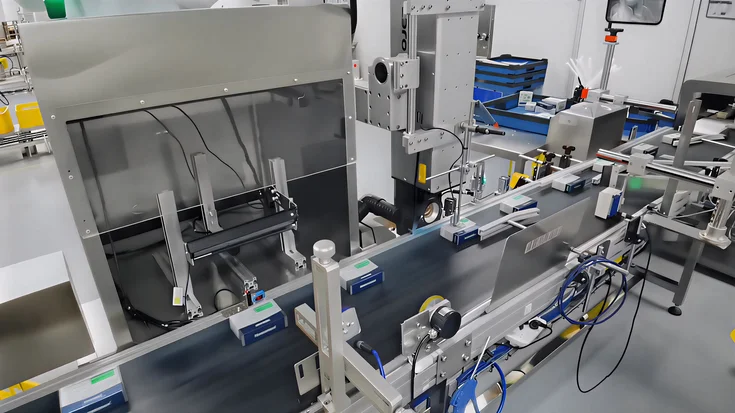
Dynamic OCR inspection with HALCON ensures maximum product quality
In the pharmaceutical industry, strict compliance regulations require medical product packaging to be correctly labeled before delivery. To meet these requirements, the Chinese company Shenzhen Jiangrun Xuneng Technology has developed a powerful mach…
Show full Story
HALCON
Medical Supplies & Pharmaceutical
Bar Code & 2D Code Reading
OCR
MVTec HALCON product icon
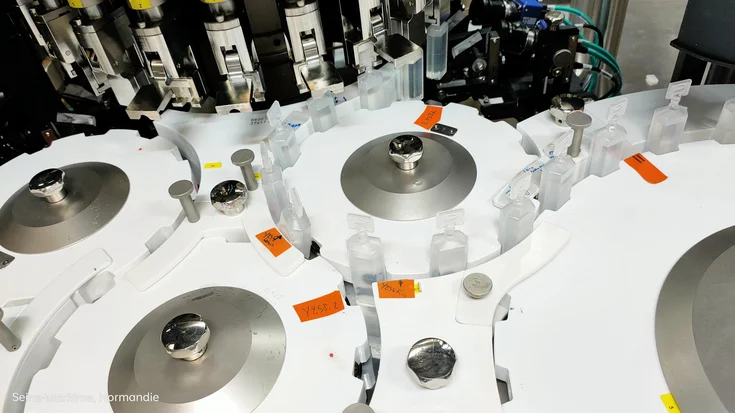
Automatisierte Transport- und Inspektionsstation für pharmazeutische Ampullen mit Machine-Vision-System von Aspen.
AI-powered machine vision automates quality inspection in the pharmaceutical industry
The pharmaceutical company Aspen is improving the quality inspection of filled ampoules with the MVTec HALCON machine vision software and the consulting and technical support services provided by MVTec. With deep learning methods, the company has sig…
Show full Story
HALCON
Medical Supplies & Pharmaceutical
Blob Analysis
Deep Learning
Matching
MVTec HALCON product icon
University of Paderborn, Heinz Nixdorf Institute
The Heinz Nixdorf Institute (HNI) joined the MVTec on Campus program in 2022. The University of Paderborn is a renowned research and educational institution specializing in the field of computer science and its applications in the context of digital…
Show full Story
HALCON
Robotics
Education, Research & Science
MVTec HALCON product icon
Intelligent Image Recognition for Automotive Logistics
An intelligent, database-based image recognition system supports order picking in automotive logistics. It shows staff the correct component, uses cameras to verify that packaging is ready for shipment, and enables seamless documentation. The solutio…
Show full Story
HALCON
Automotive
Packaging & Logistics
Object Detection
MVTec HALCON product icon
Line-scan vision system diagram used for inspecting printed materials with defect detection along a conveyor.
Industrial Inspection: Line-scan-based vision system tackles color print inspection - Daheng Image Vision
Daheng Image Vision uses a line-scan vision system with two Teledyne DALSA cameras and MVTec HALCON to inspect color prints on conveyor belts at 300 m/min. The system reliably detects ink spots, embossing errors, and misregistration, enabling compreh…
Show full Story
HALCON
Glass, Metal, Paper, Foil & Printing
Alignment
Classification
Matching
MVTec HALCON product icon
X-ray film dosimeter badges and opened cassettes with different metal filters inspected by a machine vision system.
Vision System Inspects X-ray Dosimeter Badges – Helmholtz-Zentrum
Helmholtz-Zentrum Munich uses HALCON to fully automate the evaluation of approximately 120,000 X-ray dosimeter films per month. Optical density, film type, and dosimeter numbers are precisely captured, and radiation sources are analyzed. The system s…
Show full Story
HALCON
Medical Supplies & Pharmaceutical
Calibration
Filtering
Matching
Measuring
OCR
MVTec HALCON product icon
Workflow der Produktion zylindrischer Lithium-Ionen-Batterien mit verteilten Sensorsystemen und zentraler Deep-Learning-Auswertung mit MVTec HALCON.
MVTec HALCON’s deep learning helps Panasonic Energy to propel automotive battery production
Panasonic Energy manufactures automotive batteries, for which demand is increasing worldwide, at multiple sites in Japan and North America. The company recently implemented MVTec HALCON’s deep learning technologies on a large scale at its Kansas plan…
Show full Story
HALCON
Battery Production
Automotive
Deep Learning
Inspection
MVTec HALCON product icon
Advancing machine vision education at Reutlingen University
At Reutlingen University, Professor Arnd Buschhaus has been integrating MVTec HALCON into the teaching curriculum since 2018. HALCON is used extensively in courses related to robotics and machine vision, providing students with practical experience i…
Show full Story
Education, Research & Science
3D Vision
Blob Analysis
Classification
MVTec HALCON product icon
Robotic welding cell inspecting car body weld seams using machine vision.
Machine vision optimizes quality inspection in automotive production
Consistently high quality is an absolute must in automotive production. To ensure that welded connections in body shells meet these standards, DGH has developed an application that automatically inspects them and identifies anomalies. The MVTec HALCO…
Show full Story
HALCON
Automotive
Anomaly Detection
Deep Learning
Inspection
MVTec HALCON product icon
High-speed battery inspection using machine vision.
Machine Vision automates and optimizes battery inspection
A variety of defects can occur during battery production. Averna has developed a method for the automated inspection of batteries that reliably detects all conceivable defects. Here, the machine vision software MVTec HALCON plays a key role.
Show full Story
HALCON
Battery Production
Blob Analysis
Inspection
MVTec HALCON product icon
Automated robot cell handling vaccine vials with machine vision.
Machine Vision automates vaccine production
A global company needed to quickly ramp up vaccine production. Goldfuß engineering GmbH and SIMON IBV GmbH developed a robot-based solution for loading and unloading trolleys with the vaccine vials. The machine vision software HALCON ensures the seam…
Show full Story
HALCON
Robotics
Medical Supplies & Pharmaceutical
3D Vision
MVTec HALCON product icon
Micromechanical part measured with machine vision for high-precision inspection.
Machine vision improves the measuring process of precision and micro components
The precise inspection of very small precision components, for example in watchmaking, is a challenge. Petitpierre, the Swiss specialist for high-precision technology, has developed sophisticated applications with which micromechanical components can…
Show full Story
HALCON
Matching
Measuring
MVTec HALCON product icon
Industrial robots performing laser welding on battery cells guided by machine vision.
Machine vision accelerates battery production
High speed, precision, and reliability: These are the determining factors for battery production. To meet the rapidly growing demand for batteries, companies are developing increasingly efficient production processes. Laserax has developed a new syst…
Show full Story
HALCON
Battery Production
3D Calibration
Calibration
Matching
MVTec HALCON product icon
Robotic manufacturing cell assembling satellite panels with optical solar reflectors using machine vision.
Seeing robots process large work area with high precision
The automation specialist AKEOPLUS has developed an innovative robotic cell for the production of satellite panels at the global space manufacturer Thales Alenia Space. The special feature: robots place the components with high absolute accuracy to a…
Show full Story
HALCON
Robotics
3D Vision
Matching
MVTec HALCON product icon
Students and researchers using a robot with machine vision in a university lab to demonstrate the impact of MVTec HALCON on education and research.
Technical University of Applied Sciences Würzburg-Schweinfurt
At Technical University of Applied Sciences Würzburg-Schweinfurt (THWS), Professor Christian Zirkelbach is teaching robotics and machine vision at Faculty of Applied Natural Sciences and Humanities. He has integrated advanced machine vision tools int…
Show full Story
HALCON
Robotics
Education, Research & Science
3D Vision
Deep Learning
MVTec HALCON product icon
Aluminum bottles on a production line identified by OCR using machine vision for automated quality control.
Empty bottle? Not with Deep OCR
To identify products quickly and reliably, even in difficult circumstances, machine vision has proven its worth. The company Visione Artificiale also relies on machine vision for its system to trace aluminum bottles during production. Within this sys…
Show full Story
HALCON
Food & Beverage
OCR
MVTec HALCON product icon
Operating personnel using the PackCheck machine vision solution for quality control in food packaging production.
Machine vision for every taste
The Dutch company PackCheck BV ensures packaging quality in the food industry with a modular solution. Part of the solution is the machine vision software HALCON from MVTec Software GmbH. This enables the company to increase the efficiency of packagi…
Show full Story
HALCON
Food & Beverage
Bar Code & 2D Code Reading
Blob Analysis
Matching
OCR
MVTec HALCON product icon
Hand-eye calibration enabling precise alignment between camera and robot for accurate gripping of accessory bags.
Perfectly positioned plastic bags – with classic machine vision and deep learning
Consistently automated pick-and-place activities require the reliable gripping of differently shaped and translucent objects. TEKVISA has implemented a sophisticated application that enables reliable gripping even with complex surfaces with the help…
Show full Story
HALCON
Robotics
Deep Learning
MVTec HALCON product icon
Fully automated packaging inspection system using machine vision for inline quality control in food packaging.
Deep learning detects defects in the food industry
Automation specialist INNDEO has developed a sophisticated automation solution for quality control in the packaging industry. Thanks to machine vision and deep learning technologies, high speeds and defect detection rates are no longer a problem.
Show full Story
HALCON
Food & Beverage
Deep Learning
OCR
MVTec Software